


More than half of American employees report that stress is the greatest barrier to their workplace productivity. For mid-level professionals balancing bilingual demands and team leadership, the pressures of modern work can quickly erode mental wellness. Understanding what mental wellness truly means and why it matters offers a powerful way to regain control, nurture resilience, and build a healthier environment where both individuals and organizations thrive.
Table of Contents
- Defining Mental Wellness And Its Value
- Types Of Mental Wellness Investments
- How Mental Wellness Boosts Productivity
- Financial Impact And Return On Investment
- Common Pitfalls To Avoid In Workplace Wellness
- Practical Strategies For Long-Term Impact
Key Takeaways
| Point | Details |
|---|---|
| Holistic Approach to Mental Wellness | Organizations should integrate individual and systemic strategies to foster psychological health and productivity. |
| Importance of Leadership Engagement | Purposeful leadership is essential for embedding mental wellness into organizational culture and strategies. |
| Investment in Mental Health Yields Returns | Strategic mental wellness investments can lead to significant financial and productivity gains for organizations. |
| Preventing Common Pitfalls | To ensure effective wellness programs, organizations must avoid narrow approaches and prioritize comprehensive, multi-level strategies. |
Defining Mental Wellness and Its Value
Mental wellness represents more than just an absence of mental illness. It is a dynamic state of psychological resilience, emotional balance, and personal potential. According to the World Health Organization, mental wellness encompasses an individual’s ability to realize their capabilities, manage life’s typical stresses, work productively, and meaningfully contribute to their community.
At its core, mental wellness involves multiple interconnected dimensions. These include emotional regulation, psychological flexibility, self-awareness, and the capacity to develop healthy coping mechanisms. Global research from the Wellness Institute highlights that mental wellness is not a static condition but a continuous process of growth, adaptation, and personal development.
Professionals increasingly recognize mental wellness as a critical component of overall health and workplace performance. Individuals who prioritize their mental well-being demonstrate enhanced creativity, improved decision-making skills, stronger interpersonal relationships, and greater resilience under pressure. These attributes translate directly into higher productivity, better team dynamics, and increased organizational effectiveness.
The contemporary understanding of mental wellness extends beyond individual interventions. It requires a holistic approach that integrates personal strategies, organizational support, and societal resources. This means creating environments that promote psychological safety, providing accessible mental health resources, and destigmatizing conversations about emotional well-being.
Pro tip: Start your mental wellness journey by dedicating just 10 minutes daily to mindful reflection, whether through meditation, journaling, or quiet contemplation.
Types of Mental Wellness Investments
Mental wellness investments encompass a diverse range of strategic approaches designed to support psychological health and professional development. Research from the Global Wellness Institute identifies several key categories of investment that professionals can leverage to enhance their mental well-being and workplace performance.
These investments can be broadly classified into five primary domains: self-improvement, mindfulness practices, environmental optimization, sleep enhancement, and cognitive development. Self-improvement initiatives might include personal coaching, skill development workshops, and targeted psychological training. Mindfulness practices involve meditation, breathing techniques, and stress management programs that help individuals develop emotional regulation and psychological resilience.
Cross-disciplinary research on mental capital highlights the importance of holistic investment strategies that go beyond individual interventions. This approach considers systemic factors like workplace culture, social support networks, and organizational policies that contribute to mental wellness. Organizations are increasingly recognizing that effective mental wellness investments require comprehensive strategies addressing psychological, social, and professional dimensions.
Effective mental wellness investments are not one-size-fits-all. They require personalized approaches that consider individual differences, professional contexts, and specific organizational needs. Successful implementation involves continuous assessment, adaptive strategies, and a commitment to creating supportive environments that prioritize psychological well-being alongside professional performance.
Here’s a concise overview of key domains of mental wellness investment and their unique benefits:
| Investment Domain | Example Activities | Workforce Benefit |
|---|---|---|
| Self-Improvement | Coaching, skill workshops | Enhanced personal growth |
| Mindfulness Practices | Meditation, breathing exercises | Improved stress regulation |
| Environmental Optimization | Ergonomic setups, nature access | Boosted focus and comfort |
| Sleep Enhancement | Sleep tracking, rest education | Higher energy and alertness |
| Cognitive Development | Brain training, learning programs | Sharper problem-solving |
Pro tip: Conduct a personal mental wellness audit every six months to reassess and recalibrate your investment strategies based on changing professional and personal circumstances.
How Mental Wellness Boosts Productivity
Mental wellness is not just a personal benefit but a critical driver of workplace performance. Research from Harvard Business School demonstrates a compelling link between employee well-being and organizational productivity, revealing that strategic mental wellness investments can generate performance gains of approximately 10%.
The productivity enhancement stems from multiple interconnected psychological mechanisms. Emotional regulation enables professionals to manage stress more effectively, maintain focus during challenging tasks, and navigate complex interpersonal dynamics with greater resilience. Employees with robust mental wellness demonstrate improved cognitive functioning, which translates into higher-quality decision-making, enhanced creativity, and more nuanced problem-solving capabilities.

Beyond individual performance, mental wellness significantly impacts team dynamics and organizational culture. Professionals who prioritize their psychological health contribute to a more positive workplace environment, characterized by stronger communication, increased empathy, and more collaborative interactions. These collective psychological resources create a multiplier effect, where individual wellness investments generate broader organizational benefits such as reduced conflict, improved team cohesion, and more innovative workplace interactions.
The economic implications of mental wellness are profound. Companies investing in comprehensive mental health support experience not just productivity improvements, but also reduced absenteeism, lower healthcare costs, and enhanced talent retention. These strategic investments create a virtuous cycle where employee well-being and organizational performance reinforce and elevate each other.
Pro tip: Implement a daily 15-minute mindfulness practice to reset your cognitive resources and maintain peak mental performance throughout your workday.
Financial Impact and Return on Investment
Comprehensive research on mental wellness investments reveals a compelling financial narrative that extends far beyond traditional cost-benefit analyses. The Social Return on Investment (SROI) methodology demonstrates that strategic mental wellness programs generate substantial economic value, with returns ranging from £0.79 to £28.00 for every pound invested.
The financial impact of mental wellness investments manifests through multiple channels. Direct economic benefits include reduced healthcare expenditures, decreased absenteeism, and enhanced workforce productivity. Organizations implementing comprehensive mental health strategies typically experience significant cost savings through lower staff turnover, reduced medical claims, and improved overall organizational performance. These investments translate into tangible financial outcomes that positively impact both individual employee well-being and organizational fiscal health.
Beyond immediate financial returns, mental wellness investments generate long-term strategic advantages. Companies that prioritize psychological health create more resilient workforce ecosystems, characterized by enhanced innovation, stronger team collaboration, and superior talent attraction and retention. These intangible assets contribute to sustained competitive advantage, enabling organizations to build robust human capital that can adapt to complex and rapidly changing professional environments.
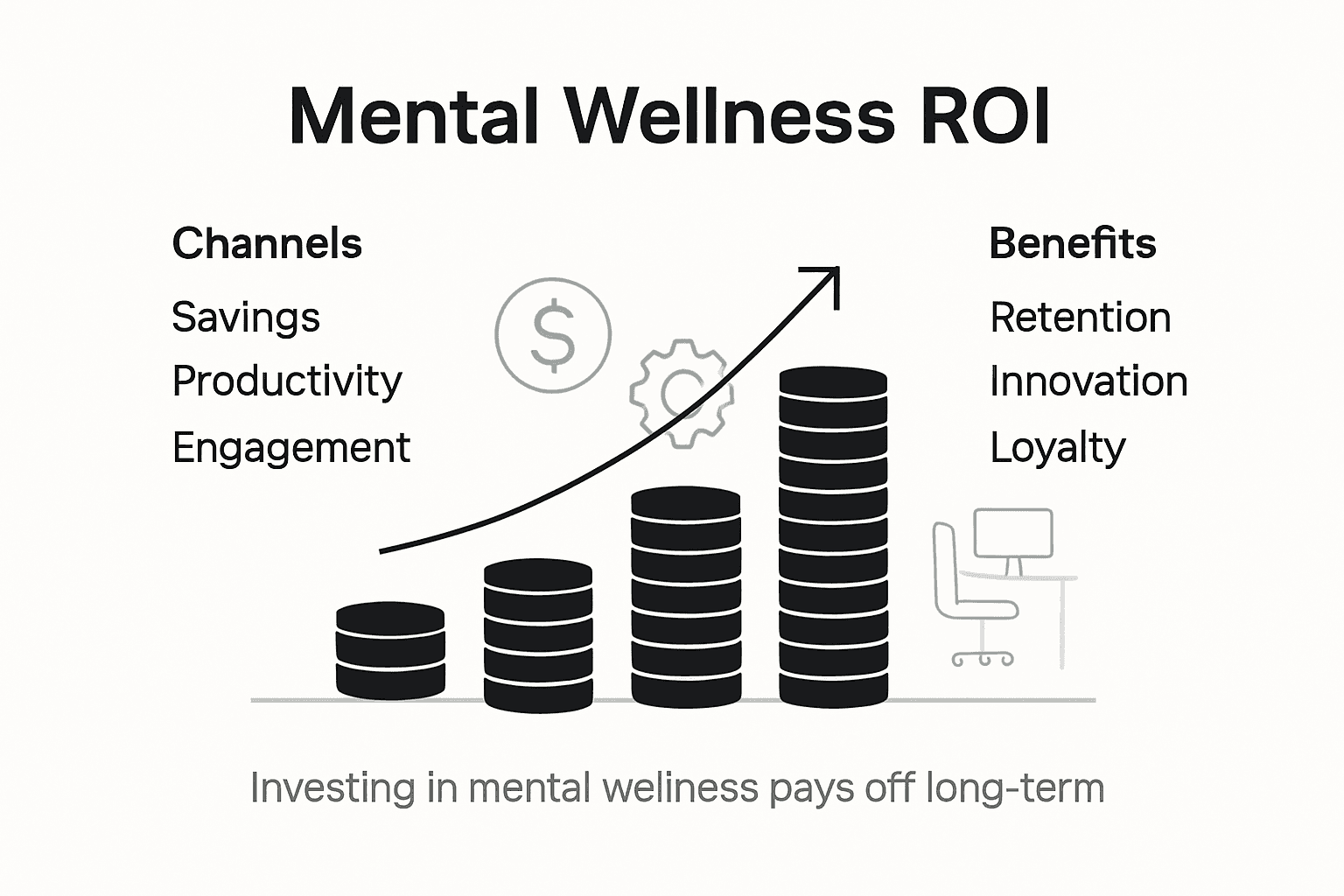
The economic rationale for mental wellness investments is increasingly clear. Forward-thinking organizations recognize that these strategies are not expenditures but critical investments in human potential. By allocating resources to psychological support, professional development, and holistic well-being, companies can create virtuous cycles of performance, engagement, and sustainable growth.
The table below summarizes major financial outcomes of mental wellness investments for organizations:
| Financial Channel | Tangible Outcome | Strategic Advantage |
|---|---|---|
| Reduced Absenteeism | Lower lost workdays | More consistent productivity |
| Lower Healthcare Costs | Fewer medical claims | Long-term cost savings |
| Improved Retention | Decreased turnover expenses | Stronger institutional memory |
| Increased Productivity | Higher output per employee | Competitive market position |
Pro tip: Develop a standardized tracking mechanism to quantify the financial and performance impacts of your mental wellness initiatives, using metrics like productivity gains, reduced turnover, and employee satisfaction scores.
Common Pitfalls to Avoid in Workplace Wellness
Comprehensive research on workplace wellness interventions reveals critical systemic challenges that can undermine even well-intentioned mental health strategies. Organizations frequently stumble by adopting a narrow, single-level approach that fails to address the complex ecosystem of workplace psychological wellness.
Systematic analyses across multiple studies highlight several key pitfalls organizations must strategically navigate. The most significant challenges include inadequate cultural integration, minimal leadership engagement, insufficient follow-up mechanisms, and a tendency to overlook systemic organizational factors. Many wellness programs mistakenly treat mental health as an individual responsibility, rather than a comprehensive organizational commitment requiring multilevel strategic interventions.
Effective workplace wellness demands a holistic perspective that considers individual, team, and organizational dimensions. Unsuccessful programs often share common characteristics: they are typically reactive instead of proactive, lack measurable goals, fail to personalize interventions, and do not create sustainable support structures. Successful strategies require continuous assessment, adaptive programming, and genuine commitment from leadership to create a psychologically supportive environment that goes beyond superficial wellness initiatives.
Preventing these pitfalls requires a sophisticated, nuanced approach. Organizations must develop integrated wellness strategies that align individual needs with broader organizational objectives, create transparent communication channels, provide ongoing education, and establish clear metrics for measuring psychological well-being and performance impact. This approach transforms wellness from a disconnected program to a core organizational value.
Pro tip: Conduct a comprehensive wellness ecosystem audit annually, involving employees at all levels to identify potential gaps and develop more integrated, context-specific mental health strategies.
Practical Strategies for Long-Term Impact
Evidence-based workplace wellness frameworks reveal that successful long-term mental health strategies require a sophisticated, multi-dimensional approach. Purposeful leadership emerges as a critical foundation, transforming wellness from a peripheral initiative to a core organizational priority that systematically addresses individual, team, and systemic psychological needs.
Comprehensive employer research suggests implementing practical strategies across several key dimensions. These include developing integrated policies, creating continuous feedback mechanisms, conducting regular risk assessments, and designing targeted interventions that recognize the unique psychological landscapes of different employee groups. Successful strategies move beyond one-size-fits-all solutions, instead crafting nuanced approaches that adapt to evolving workplace dynamics and individual employee needs.
Effective long-term mental wellness requires a holistic ecosystem approach. Organizations must cultivate supportive cultural environments that normalize conversations about psychological health, provide accessible resources, and embed well-being considerations into performance management, leadership development, and organizational design. This means training managers to recognize psychological signals, creating psychologically safe communication channels, and developing resilience-building programs that enhance individual and collective emotional intelligence.
Sustainable mental wellness strategies demand ongoing measurement, adaptive programming, and genuine organizational commitment. Leaders must establish clear metrics for tracking psychological well-being, invest in continuous learning and development, and create transparent mechanisms for employees to provide feedback and shape wellness initiatives. By treating mental health as a dynamic, collaborative process rather than a static program, organizations can build more resilient, engaged, and high-performing workforce ecosystems.
Pro tip: Implement quarterly wellness pulse surveys and create cross-functional teams that include employees from diverse roles to design and evaluate mental health initiatives.
Invest in Your Mental Wellness for Lasting Professional Success
The challenge of sustaining mental wellness while navigating workplace pressures is clear from the article. Struggling with stress management, emotional regulation, and building resilience can hinder your productivity and personal growth. If you want to avoid common pitfalls like one-size-fits-all solutions and instead invest in a personalized approach that enhances your mental wellness and professional performance, explore expert guidance tailored to your needs. Concepts such as mindfulness practices, cognitive development, and environmental optimization become accessible tools when supported by the right coaching and resources.
Take the first step today toward improving your mental wellness by connecting with Monika Varela. As a psychologist and mindfulness coach, she offers evidence-based psychotherapy, corporate training, and mindfulness workshops designed to foster emotional balance and sustained productivity. Visit Monika Varela’s website to learn more about her services and start your personalized journey to professional success. Discover how mindfulness coaching and communication skills training can empower you and your organization to thrive.
Act now to embrace a holistic mental wellness strategy that brings measurable improvements and a competitive edge to your career and workplace.
Frequently Asked Questions
What is mental wellness and why is it important for professional success?
Mental wellness is a dynamic state of psychological resilience, emotional balance, and personal potential. It is crucial for professional success because it enhances creativity, decision-making skills, and interpersonal relationships, leading to higher productivity and better team dynamics.
How can investing in mental wellness improve workplace productivity?
Investing in mental wellness boosts productivity by enhancing emotional regulation, enabling better stress management, improving cognitive functioning, and fostering a positive team environment. This leads to improved decision-making and problem-solving capabilities.
What are some practical strategies for promoting mental wellness in the workplace?
Practical strategies include developing integrated wellness policies, creating continuous feedback mechanisms, conducting regular risk assessments, and designing targeted interventions that cater to the unique psychological needs of employees.
What are the financial benefits of mental wellness investments for organizations?
Mental wellness investments can lead to reduced absenteeism, lower healthcare costs, improved retention, and increased productivity. These benefits contribute to substantial financial returns, creating a supportive environment that enhances overall organizational performance.






Aún no hay comentarios, ¡añada su voz abajo!