


Most American organizations now recognize that traditional management approaches often fall short when it comes to building truly effective teams. With over 80 percent of mid-level leaders reporting a desire for more meaningful development, the coaching role in leadership has never been more vital. Exploring coaching together with mindfulness gives corporate leaders practical ways to increase team engagement, create adaptable work cultures, and inspire stronger connections at every level.
Table of Contents
- Defining The Coach’s Role In Modern Leadership
- Key Coaching Styles For Corporate Leaders
- Essential Coaching Skills And Mindfulness Practices
- Impact Of Leadership Coaching On Team Performance
- Common Pitfalls In Coaching Leadership Roles
Key Takeaways
| Point | Details |
|---|---|
| Coach as Strategic Partner | Modern leadership coaches facilitate personal and professional growth, focusing on emotional intelligence and holistic development rather than just task completion. |
| Diverse Coaching Styles | Effective coaches adapt their methods to individual needs using various styles—directive, supportive, collaborative, and transformational—to enhance leadership effectiveness. |
| Importance of Mindfulness | Mindfulness practices like reflective journaling and active listening are essential skills for coaches, fostering emotional awareness and constructive feedback in leadership development. |
| Recognizing Pitfalls | Coaches should avoid rigid approaches and maintain self-awareness to ensure they adapt their methods effectively and support leaders without projecting personal biases. |
Defining the Coach’s Role in Modern Leadership
Leadership coaching has emerged as a transformative approach to organizational development, moving far beyond traditional management techniques. Coaches now serve as strategic partners who help leaders unlock their potential, navigate complex interpersonal dynamics, and drive meaningful organizational change. Unlike traditional supervisors who primarily focus on task completion, modern leadership coaches concentrate on holistic professional growth and emotional intelligence.
The coach’s role involves multiple critical dimensions that extend well beyond simple performance management. These professionals act as facilitators of personal and professional transformation, helping leaders develop self-awareness, emotional regulation, and advanced communication skills. Through targeted interventions, coaches help leaders recognize their inherent strengths, address potential blind spots, and create sustainable strategies for personal and team development. This approach requires deep psychological insight, active listening skills, and the ability to ask probing questions that challenge existing mental frameworks.
In contemporary corporate environments, coaches serve as external catalysts for organizational adaptability. They bring specialized perspectives that internal management might overlook, providing neutral, objective guidance designed to enhance leadership effectiveness. Successful coaches understand that their primary objective is not to dictate solutions but to empower leaders to discover their own insights and develop authentic leadership styles. By creating safe, non-judgmental spaces for exploration and reflection, coaches enable leaders to experiment with new approaches, take calculated risks, and cultivate more resilient, adaptive team dynamics.
Pro Coaching Tip: Invest in regular reflective practice sessions with your leadership coach, focusing on understanding your personal leadership narrative and identifying unconscious patterns that might be limiting your team’s potential.
Practical Insight: Before selecting a leadership coach, conduct thorough interviews to ensure their approach aligns with your organization’s specific cultural context and strategic objectives.
Key Coaching Styles for Corporate Leaders
Leadership coaching encompasses a diverse range of approaches designed to meet the complex needs of modern corporate environments. Organizational leaders can develop multiple coaching styles that adapt to different team dynamics, individual personalities, and strategic objectives. The most effective coaches recognize that no single approach works universally, instead crafting flexible methodologies that respond to unique organizational contexts.
Four primary coaching styles emerge as particularly impactful in corporate settings. Directive Coaching focuses on providing clear, specific guidance and structured recommendations. Supportive Coaching emphasizes emotional support and personal development, creating safe spaces for vulnerability and growth. Collaborative Coaching involves mutual problem-solving and co-creation of strategies, treating leaders as active partners in their developmental journey. Transformational Coaching goes beyond immediate performance, targeting deep psychological shifts that enable fundamental changes in leadership approach and organizational culture.
Multi-style leadership models highlight the importance of coaches’ ability to seamlessly transition between these approaches. Successful coaches possess emotional intelligence that allows them to read contextual nuances and select the most appropriate coaching style. This adaptive capability means understanding when to offer direct advice, when to provide empathetic support, and when to challenge existing mental frameworks that might be limiting leadership potential.

The selection of an appropriate coaching style depends on multiple factors, including the leader’s experience level, organizational culture, current challenges, and individual learning preferences. Effective coaches conduct thorough initial assessments to determine the most suitable approach, ensuring that their intervention creates meaningful, sustainable improvements in leadership effectiveness.
Pro Coaching Strategy: Develop a flexible coaching toolkit that allows you to smoothly transition between different coaching styles based on immediate organizational needs and individual leader characteristics.
Practical Insight: Regularly solicit feedback from coached leaders to refine and adjust your coaching approach, ensuring continuous alignment with their developmental goals.
Here’s a quick overview comparing the four primary coaching styles in corporate leadership:
| Coaching Style | Key Focus | Typical Use Case | Leadership Outcome |
|---|---|---|---|
| Directive Coaching | Clear guidance | New leaders, urgent decisions | Rapid skill acquisition |
| Supportive Coaching | Emotional development | High-stress teams, transitions | Increased confidence, resilience |
| Collaborative Coaching | Joint problem-solving | Complex challenges, innovation | Higher engagement, ownership |
| Transformational Coaching | Deep mindset shifts | Strategic change, culture shifts | Long-term behavioral change |
Essential Coaching Skills and Mindfulness Practices
Mindfulness represents a critical foundation for effective leadership coaching, transforming traditional approaches into deeply reflective, emotionally intelligent practices. Advanced coaching techniques now integrate technological innovations that support self-reflection and personal growth, moving beyond conventional mentorship models. These approaches recognize that true leadership development requires profound inner work and systematic skill cultivation.
Essential coaching skills encompass multiple interconnected competencies. Active Listening emerges as a fundamental skill, requiring coaches to create space for leaders to explore their inner landscape without judgment. Emotional intelligence plays a crucial role, enabling coaches to read subtle interpersonal dynamics and provide nuanced guidance. Multimodal feedback mechanisms have revolutionized coaches’ ability to understand behavioral cues, allowing for more precise and targeted interventional strategies that support leadership transformation.
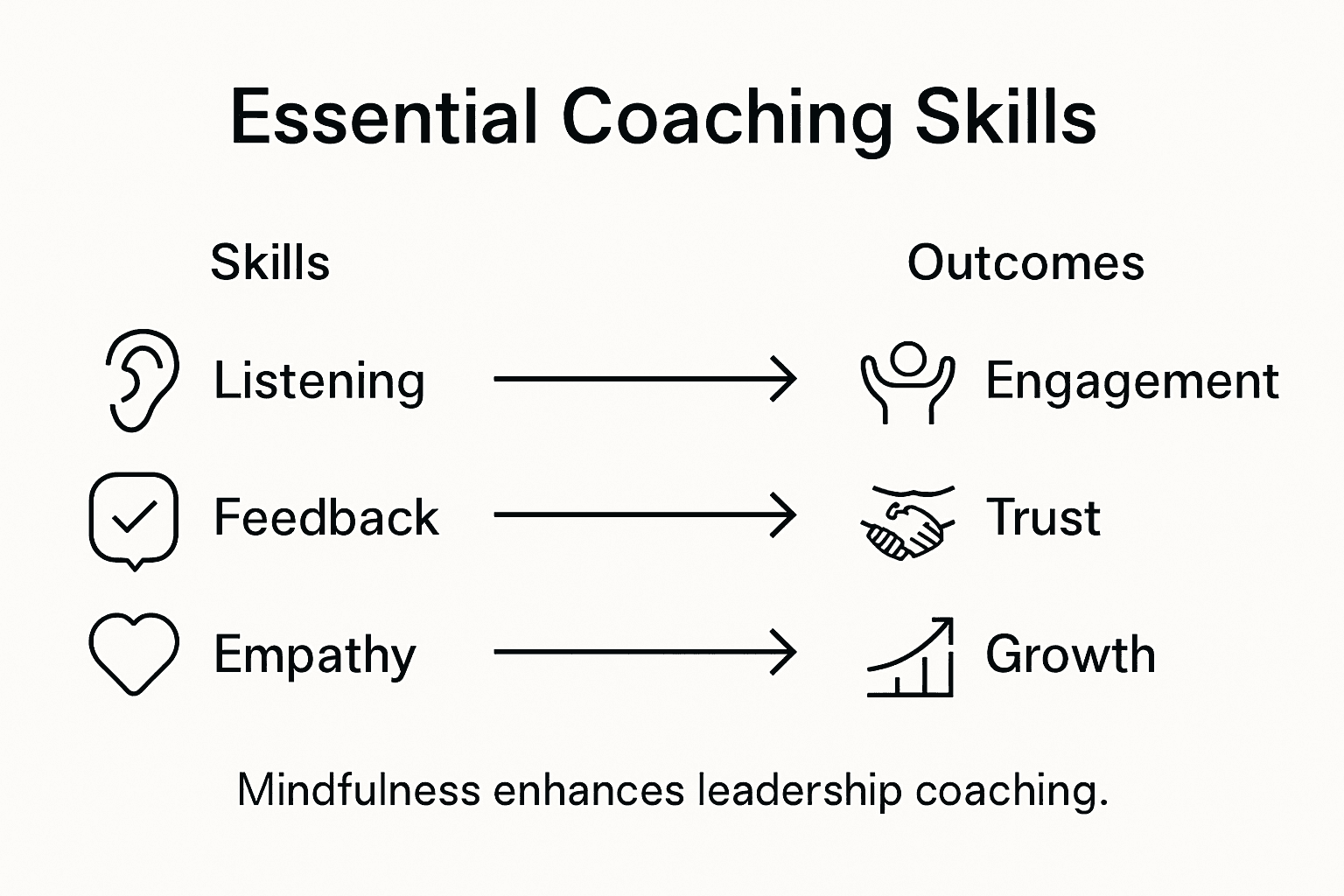
Mindfulness practices serve as powerful tools for developing these advanced coaching capabilities. Techniques such as meditation, reflective journaling, and somatic awareness training help coaches cultivate the internal resources necessary for deep, transformative interactions. These practices enable coaches to maintain present-moment awareness, regulate their own emotional responses, and create psychologically safe environments where leaders can explore vulnerability, challenge existing mental frameworks, and develop more adaptive leadership approaches.
Successful coaches understand that their personal development directly influences their capacity to support others. This requires ongoing commitment to self-reflection, continuous learning, and intentional practice of mindfulness techniques that enhance emotional regulation, empathy, and strategic thinking. By integrating personal growth with professional development, coaches become catalysts for meaningful organizational transformation.
Pro Mindfulness Strategy: Develop a daily mindfulness practice that includes meditation, reflective journaling, and intentional emotional awareness exercises to enhance your coaching effectiveness.
Practical Insight: Regularly assess your coaching approach through structured self-reflection, seeking feedback from coached leaders to identify areas for personal and professional growth.
The table below highlights essential coaching skills and their business impact:
| Coaching Skill | Description | Business Impact |
|---|---|---|
| Active Listening | Attentive, unbiased leader conversations | Trust and better decision-making |
| Emotional Intelligence | Understanding and managing emotions | Stronger relationships, fewer conflicts |
| Mindfulness | Present-moment awareness during coaching | Improved clarity, reduced stress |
| Multimodal Feedback | Using varied data for insights | More targeted leadership development |
Impact of Leadership Coaching on Team Performance
Effective leadership coaching creates transformative organizational dynamics that extend far beyond individual professional development. By targeting core leadership competencies, coaching interventions generate cascading positive effects throughout entire team structures. These strategic approaches recognize that leadership is not a solitary pursuit but a complex ecosystem of interpersonal interactions, communication patterns, and collective psychological resources.
Emotional intelligence emerges as a critical mechanism through which leadership coaching drives team performance. Advanced research demonstrates how emotional intelligence fundamentally shapes team cohesion by enhancing communication, conflict resolution, and collective motivation. Coaches help leaders develop nuanced emotional awareness that allows them to recognize subtle team dynamics, address underlying interpersonal tensions, and create psychologically safe environments where individual team members can authentically contribute their unique strengths.
The impact of leadership coaching manifests through multiple interconnected performance dimensions. Coaches assist leaders in developing strategic self-awareness, enabling them to understand their personal leadership style’s strengths and limitations. This metacognitive approach allows leaders to adapt their communication, delegation, and motivation strategies to match specific team members’ needs. By fostering individual growth while simultaneously maintaining a holistic team perspective, leadership coaching transforms organizational culture from reactive problem-solving to proactive opportunity creation.
Successful leadership coaching recognizes that team performance is not about enforcing rigid structures but creating adaptive, resilient systems. This requires coaches to help leaders develop complex skills such as active listening, empathetic communication, contextual intelligence, and systemic thinking. Through targeted interventions, leaders learn to view their teams as dynamic living systems rather than mechanical assemblages of human resources.
Pro Performance Strategy: Implement quarterly team coaching assessments that measure both individual leadership growth and collective team performance metrics to ensure continuous improvement.
Practical Insight: Design personalized coaching plans that balance individual leadership development with team-wide collaborative skill enhancement.
Common Pitfalls in Coaching Leadership Roles
Managerial coaching approaches often encounter systemic challenges that can undermine their effectiveness and organizational impact. These pitfalls emerge from deeply ingrained behavioral patterns, cognitive biases, and inflexible leadership paradigms that resist adaptive transformation. Understanding these potential obstacles becomes crucial for coaches seeking to create meaningful, sustainable leadership development strategies.
One primary pitfall stems from over-reliance on a single coaching style. Research highlights how rigidity in leadership approaches can significantly diminish team performance, demonstrating that coaches must develop nuanced, contextually responsive methodologies. Coaches who default to a singular approach—whether exclusively directive, supportive, or transformational—risk creating psychological disconnection and reducing their capacity to address complex team dynamics. Successful leadership coaching requires a dynamic, fluid approach that can rapidly adapt to individual leader needs and organizational contexts.
Another critical pitfall involves coaches’ inability to manage their own emotional reactivity and self-perception. Coaches with low self-awareness may unconsciously project their personal limitations, unresolved psychological patterns, or professional insecurities onto the leaders they support. This can manifest through subtle manipulation, excessive criticism, or an inability to provide constructive, empathetic feedback. The most effective coaches cultivate robust emotional intelligence, maintaining a clear boundary between professional guidance and personal projection.
Additionally, coaches frequently stumble by treating leadership development as a linear, mechanistic process rather than a complex, nonlinear journey of personal transformation. This reductive approach fails to recognize the intricate psychological, emotional, and systemic factors that shape leadership effectiveness. Coaches must move beyond prescriptive models and embrace a more holistic understanding that considers individual psychology, organizational culture, interpersonal dynamics, and broader contextual influences.
Pro Diagnostic Strategy: Conduct monthly self-assessments of your coaching approach, actively soliciting feedback from coached leaders to identify potential blind spots and unconscious biases.
Practical Insight: Develop a diverse coaching toolkit that allows flexible, personalized interventions tailored to each leader’s unique developmental trajectory.
Unlock Transformational Leadership Through Expert Coaching
Struggling to navigate the complex dynamics of modern leadership? This article highlights key challenges such as adapting coaching styles, fostering emotional intelligence, and avoiding common pitfalls that often limit team performance. If you want to embrace a flexible, mindful approach that empowers authentic leadership and transforms team dynamics, it is essential to build self-awareness and integrate advanced coaching skills.
Discover how Monika Varela’s expertise in psychology and mindfulness coaching can help you master these critical skills. Her personalized services focus on emotional regulation, active listening, and strategic leadership development tailored to your unique organizational culture. Visit Monika Varela today to explore transformative mindfulness workshops, enhance your communication skills, and unlock your leadership potential. Act now to begin your journey toward creating resilient teams and thriving workplaces.
Frequently Asked Questions
What is the role of a coach in modern leadership?
The role of a coach in modern leadership is to serve as a strategic partner who aids leaders in unlocking their potential, enhancing emotional intelligence, and driving meaningful organizational change through personal and professional growth.
How does leadership coaching impact team dynamics?
Leadership coaching improves team dynamics by fostering emotional intelligence in leaders, which enhances communication, conflict resolution, and collective motivation, ultimately leading to stronger team cohesion and performance.
What are the different coaching styles used in corporate leadership?
The main coaching styles in corporate leadership include Directive Coaching, Supportive Coaching, Collaborative Coaching, and Transformational Coaching, each serving distinct purposes based on team dynamics and individual needs.
Why is mindfulness important in leadership coaching?
Mindfulness is crucial in leadership coaching as it helps coaches cultivate self-awareness and emotional regulation, creating a safe and supportive environment for leaders to explore vulnerability and develop adaptive leadership skills.





Aún no hay comentarios, ¡añada su voz abajo!