


Most people overestimate how well they listen. According to studies, almost 90 percent of communication breakdowns happen because someone stops truly listening. In our busy lives, distractions crowd out our ability to connect with others. Mindful listening helps you cut through the noise and build stronger relationships. This guide gives you practical steps to create a focused mindset and transform everyday conversations into more meaningful, supportive exchanges.
Table of Contents
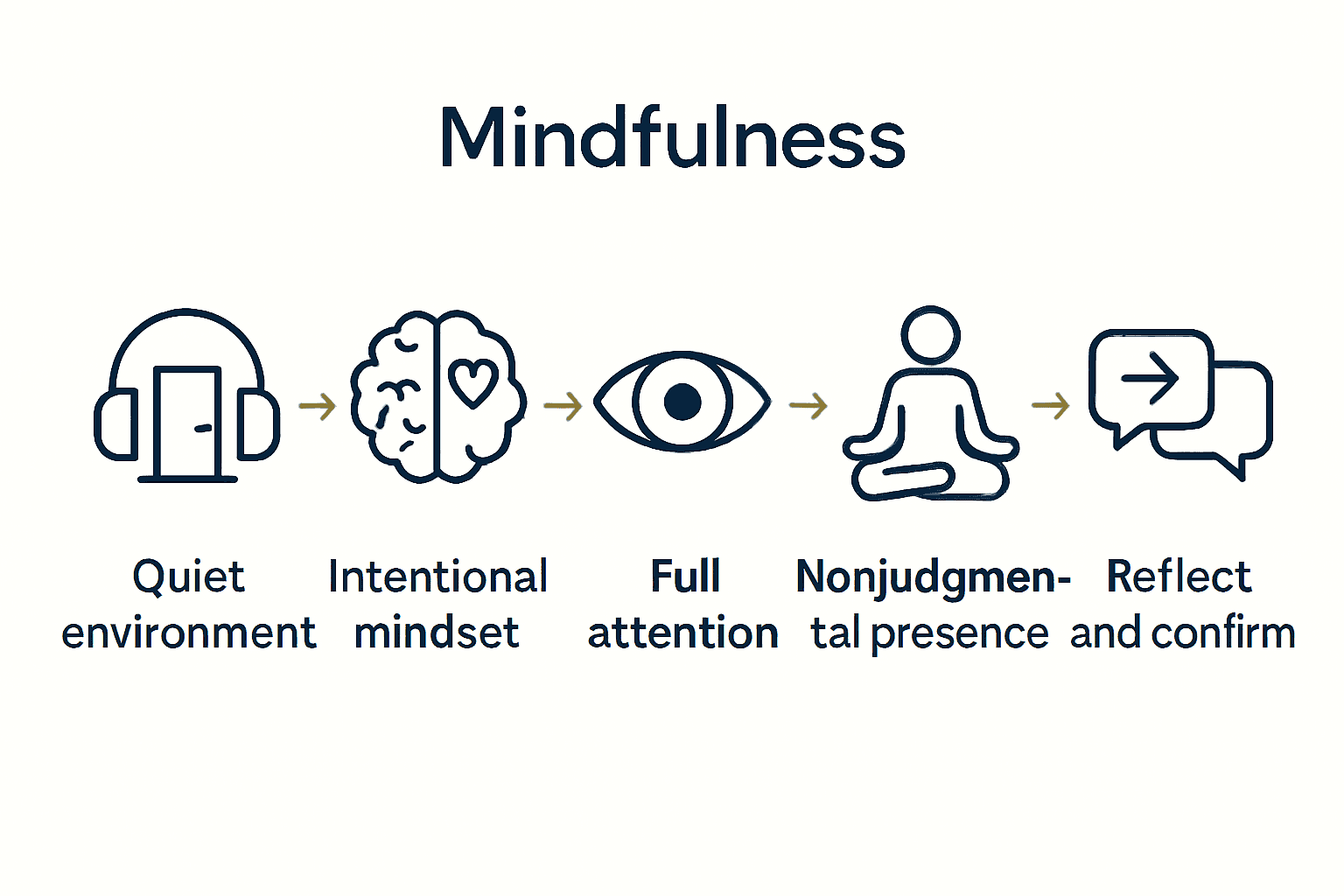
- Step 1: Prepare Your Listening Environment
- Step 2: Set An Intentional Listening Mindset
- Step 3: Focus Fully On The Speaker
- Step 4: Apply Nonjudgmental Presence Techniques
- Step 5: Reflect And Confirm Understanding
Quick Summary
| Key Point | Explanation |
|---|---|
| 1. Create a focused listening environment | Minimize distractions by choosing a quiet space and turning off notifications to enhance focus on the speaker. |
| 2. Cultivate an intentional listening mindset | Approach conversations with genuine curiosity, releasing judgments and internal narratives for deeper understanding. |
| 3. Maintain full attention on the speaker | Position yourself facing the speaker and practice active listening to absorb both words and emotions effectively. |
| 4. Practice nonjudgmental presence | Acknowledge your own reactions without letting them interfere, promoting a compassionate and open listening stance. |
| 5. Reflect and confirm understanding | Use paraphrasing and open-ended questions to clarify the speaker’s message, fostering mutual respect and deeper connection. |
Step 1: Prepare Your Listening Environment
Creating the right listening environment is your first strategic move toward mindful communication. According to Calm Blog, establishing a quiet and calm setting is essential for effective mindful listening, as noise and distractions can significantly impede your ability to truly hear and understand.
Start by selecting a space where external interruptions are minimized. Turn off electronic notifications on your phone and computer, choose a room with minimal background noise, and consider using noise canceling headphones if you are in a busy environment. The goal is to create a focused atmosphere that allows you to direct your full attention to the speaker. As research suggests from ZNU Educational Files, your ability to listen effectively depends on discerning between intentional messages and environmental noise.
A pro tip: if you cannot control your entire environment, use strategic positioning. Sit facing the speaker, maintain comfortable eye contact, and position yourself where visual and auditory distractions are least likely to occur. This physical preparation signals your commitment to listening and helps you stay mentally present during the conversation. By deliberately crafting your listening environment, you set the stage for more meaningful and connected communication.
Step 2: Set an Intentional Listening Mindset
Setting an intentional listening mindset transforms ordinary conversations into meaningful connections. According to Sigma Assessment Systems, mindful listening requires a deliberate approach that involves genuine interest in what others say while avoiding immediate judgments.
To cultivate this mindset, start by consciously releasing your internal narratives and preconceptions. Before the conversation begins, take a deep breath and commit to being fully present. Your goal is not to prepare your response or evaluate the speaker, but to understand their perspective completely. As recommended by Calm Blog, approach each conversation with genuine curiosity. Prepare open-ended questions that encourage the speaker to share more deeply and demonstrate your authentic engagement.
A practical strategy is to practice what experts call radical acceptance during conversations. This means listening without trying to change the speaker’s experience or immediately offering solutions. Instead, create mental space for their thoughts and feelings. By suspending your own agenda and truly receiving the other person’s communication, you open the door to more profound understanding and connection. Your intentional listening mindset becomes a powerful tool for building trust and empathy in every interaction.
Step 3: Focus Fully on the Speaker
Learning to focus completely on the speaker is a critical skill in mindful listening that transforms conversations from mere exchanges to meaningful connections. According to research from ZNU Educational Files, paying attention to turn taking signals helps you follow the conversational flow and avoid interrupting someone while they are speaking.
To achieve full focus, start by positioning your body toward the speaker and maintaining soft but consistent eye contact. This physical orientation signals your complete engagement and helps you pick up on nonverbal cues that complement verbal communication. Put away distracting devices like phones or laptops. If you find your mind wandering, gently guide your attention back to the speaker without judgment. Practice active listening techniques such as occasional subtle nods or minimal verbal acknowledgments like “I see” or “mmhmm” to show you are fully present.
A powerful technique is to temporarily suspend your internal commentary. Resist the urge to formulate responses or judgments while the other person is speaking. Instead, imagine you are absorbing their words like a sponge absorbs water. This approach allows you to hear not just the words but the emotions and intentions behind them. By training yourself to focus fully on the speaker, you create a space of genuine understanding and respect that deepens every conversation.
Step 4: Apply Nonjudgmental Presence Techniques
Mastering nonjudgmental presence is a transformative skill that allows you to listen with genuine openness and empathy. According to Sigma Assessment Systems, mindful listening fundamentally involves avoiding interruptions, moving beyond self focus, and resisting the temptation to plan responses while others are speaking.
To cultivate a nonjudgmental presence, start by acknowledging your internal reactions without letting them hijack your listening experience. When you notice yourself forming an opinion or wanting to interrupt, pause and take a deep breath. As recommended by Calm Blog, resist the urge to interrupt even when you believe you have something important to contribute. Instead, create mental space that allows the speaker to fully express their thoughts and feelings. This means letting go of your immediate impulse to agree, disagree, offer advice, or share a similar experience.
Practice radical acceptance by recognizing that each person’s experience is valid, even if it differs from your own perspective. Imagine yourself as a compassionate witness rather than a critic or problem solver. Your goal is to understand rather than evaluate.
 By suspending judgment and truly hearing the speaker without internal commentary, you create a profound connection that transcends mere conversation and enters the realm of genuine human understanding.
Step 5: Reflect and Confirm Understanding
Reflecting and confirming understanding is the crucial bridge between listening and truly comprehending what someone has shared. According to research from ZNU Educational Files, effective listening requires identifying main points and understanding contextual nuances that influence meaning beyond just the words spoken.
To reflect and confirm understanding, use paraphrasing techniques that demonstrate you have genuinely absorbed the speaker’s message. After they finish speaking, respond with statements like “What I hear you saying is…” or “If I understand correctly, you mean…” This approach allows the speaker to confirm or clarify your interpretation. Pay attention not just to the words, but to the underlying emotions and subtle contextual cues. By reflecting back what you have heard, you create an opportunity for deeper mutual understanding and show the speaker that you are fully engaged.
A powerful technique is to ask open ended questions that invite further clarification. Instead of assuming you know exactly what was meant, use phrases like “Could you tell me more about that?” or “Help me understand what that experience was like for you.” This demonstrates humility and genuine curiosity. Remember that reflection is not about agreeing with everything said, but about creating a space of mutual understanding and respect. By mastering this skill, you transform listening from a passive activity into an active, collaborative process of connection.
Elevate Your Communication with Mindful Listening Skills
Mindful listening is essential for building deeper connections and fostering understanding in every conversation. If you find it challenging to focus fully on speakers or struggle with nonjudgmental presence as described in the Guide to Mindful Listening for Effective Communication, you are not alone. Many face difficulties pausing internal commentary and creating genuine engagement. These obstacles can leave you feeling misunderstood or disconnected.

Unlock your potential to listen actively and empathetically by exploring professional guidance and tailored mindfulness training at Monikavarela.com. Discover how Monika Varela’s expert coaching and workshops can transform your communication habits starting today. Visit our Noticias archivos – Mónika Varela to learn more about strategies for improving mindful communication. Take the first step toward truly hearing others and deepening your relationships by booking a personalized session now.
Frequently Asked Questions
How can I create a quiet environment for mindful listening?
To create a quiet environment, choose a space with minimal noise distractions and turn off electronic notifications. Aim for a setting where you can maintain full attention on the speaker to enhance your listening experience.
What are some techniques to maintain focus while listening?
To maintain focus, position your body towards the speaker and eliminate distractions like phones or laptops. Practice active listening by using subtle nods and verbal acknowledgments to stay engaged throughout the conversation.
How can I practice nonjudgmental presence during conversations?
To practice nonjudgmental presence, acknowledge your internal reactions but resist the urge to interrupt or evaluate while the other person speaks. Instead, create mental space that allows the speaker to fully express themselves, promoting true understanding and connection.
What are effective ways to reflect and confirm understanding after listening?
Effective ways to confirm understanding include paraphrasing the speaker’s message and asking open-ended questions. Use phrases like “What I hear you saying is…” to demonstrate engagement and invite the speaker to clarify any points as needed.
How can I cultivate an intentional listening mindset?
To cultivate an intentional listening mindset, consciously release preconceptions and commit to being fully present before the conversation begins. Take a deep breath and approach the discussion with genuine curiosity to foster deeper connections.





Aún no hay comentarios, ¡añada su voz abajo!