


Most American adults admit they spend over 60 percent of conversations distracted rather than fully listening. With constant notifications and noise, tuning in to another person can feel unusually challenging. Mindful listening matters now more than ever because it leads to stronger relationships and deeper understanding. By learning how to set the right environment and respond openly, you can connect more meaningfully in every conversation.
Table of Contents
- Step 1: Settle Your Mind and Environment
- Step 2: Focus Full Attention on the Speaker
- Step 3: Acknowledge and Observe Reactions
- Step 4: Respond Thoughtfully and Openly
- Step 5: Reflect and Integrate Feedback
Quick Summary
| Key Insight | Explanation |
|---|---|
| 1. Create a Distraction-Free Environment | Choose a quiet space with minimal interruptions, turning off devices to enhance focus on conversations. |
| 2. Engage Fully with Active Presence | Listen without preparing responses, focusing entirely on the speaker’s words and emotions. |
| 3. Observe Nonverbal Cues | Pay attention to body language and facial expressions, which can reveal deeper feelings behind spoken words. |
| 4. Respond with Thoughtfulness | Take time to reflect before responding, validating the speaker’s thoughts with phrases that show understanding. |
| 5. Reflect on Conversations | Review key points after discussions to learn and improve your listening skills over time. |
Step 1: Settle Your Mind and Environment
Successful mindful listening starts with creating the right physical and mental space. Your environment directly impacts your ability to listen deeply and connect authentically with others.
Begin by selecting a quiet location where interruptions are minimal. Calm experts recommend finding a space that allows your conversation to proceed smoothly. This means turning off electronic devices like smartphones and finding a location with minimal background noise. Consider a peaceful room with comfortable seating where you can maintain an open, relaxed posture.
Creating a conducive physical environment helps minimize distractions and supports present moment awareness. Position yourself facing your conversation partner and ensure your body language communicates receptiveness. Keep your shoulders relaxed, maintain gentle eye contact, and position yourself at a comfortable distance that feels neither too close nor too remote.
Pro tip: If you cannot find a perfectly quiet space, use noise canceling headphones or choose a time of day when interruptions are less likely. Remember that creating the right environment is about quality of attention more than absolute silence.
Step 2: Focus Full Attention on the Speaker
Mindful listening demands your complete mental presence and genuine engagement with the person speaking. Your goal is to understand not just the words, but the underlying emotions and intentions behind them.
Effective mindful listening requires putting away distractions and paying full attention to the conversation. This means silencing your inner dialogue and resisting the urge to interrupt or prepare your response while the other person is speaking. Think of listening as an active skill where you are fully absorbing the speaker’s message without judgment or immediate reaction.
Practice this by maintaining soft eye contact, nodding occasionally to show you are tracking their narrative, and keeping your body language open and receptive. Avoid crossing your arms or turning away, which can signal disinterest or defensiveness. Instead, angle your body slightly towards the speaker and maintain a relaxed yet attentive posture. When you catch your mind wandering, gently bring your focus back to the speaker without criticizing yourself.

Pro tip: If you find your attention drifting, try anchoring yourself by focusing on the speaker’s tone of voice, facial expressions, or the specific words they are using. This technique helps you stay present and demonstrates genuine respect for the person sharing their thoughts.
Step 3: Acknowledge and Observe Reactions
Mindful listening goes beyond hearing words it involves understanding the emotional landscape beneath the conversation. Your ability to read and respond to nonverbal communication can transform your interactions and deepen your connections.
Observing body language and emotional reactions reveals crucial insights into the speaker’s true message. Pay attention to subtle shifts in tone, facial expressions, and physical posture. Notice how someone’s shoulders might tense when discussing a challenging topic or how their eyes might brighten when sharing something exciting. These nonverbal cues often communicate more than words alone.
Understanding nonverbal signals helps you gain deeper insight into the speaker’s emotions and underlying intentions. Practice reading these signals without judgment by maintaining a curious and compassionate mindset. If you notice the speaker seems uncomfortable or hesitant, resist the urge to fill the silence. Instead, create space for them to express themselves fully by maintaining a gentle, attentive presence.
Pro tip: If you find yourself unsure about what you are observing, consider gentle clarification. A simple check in like “It seems like you might be feeling frustrated. Would you like to tell me more about that?” can help validate the speaker’s emotional experience and demonstrate your genuine engagement.
Step 4: Respond Thoughtfully and Openly
Responding thoughtfully is the art of transforming listening from a passive experience into an authentic dialogue. Your goal is to create a space of genuine understanding where both parties feel heard and respected.
Mindful listening requires patience and giving the speaker ample time to complete their thoughts before crafting a response. When you do respond, focus on reflection rather than reaction. This means pausing to digest what you have heard, acknowledging the speaker’s perspective, and sharing your thoughts without judgment or defensiveness. Use phrases that demonstrate you have truly listened such as “What I hear you saying is…” or “It sounds like you are feeling…” to validate their experience.
Practice responding with curiosity and openness. This means asking clarifying questions that invite deeper exploration rather than questions that challenge or dismiss the speaker’s perspective. Your tone should be gentle and your body language should remain welcoming. Avoid interrupting or preparing your counterargument while the other person is speaking. Instead, approach the conversation as a collaborative journey of mutual understanding.
Pro tip: If you find yourself feeling emotionally triggered, take a deep breath before responding. This small pause can help you shift from a reactive state to a more thoughtful and compassionate engagement. Remember that mindful listening is not about agreeing with everything said, but about creating a safe space for authentic communication.
Step 5: Reflect and Integrate Feedback
Mindful listening is an ongoing process of learning and growth. Reflecting on conversations helps you develop deeper understanding and improve your communication skills over time.
Periodically paraphrasing or summarizing what the speaker has shared ensures accurate understanding and demonstrates active engagement. After a conversation, take time to mentally review the key points. Ask yourself what emotions were present, what underlying messages you might have missed, and how your own assumptions might have influenced your listening. This reflective practice helps transform casual listening into a meaningful learning experience.
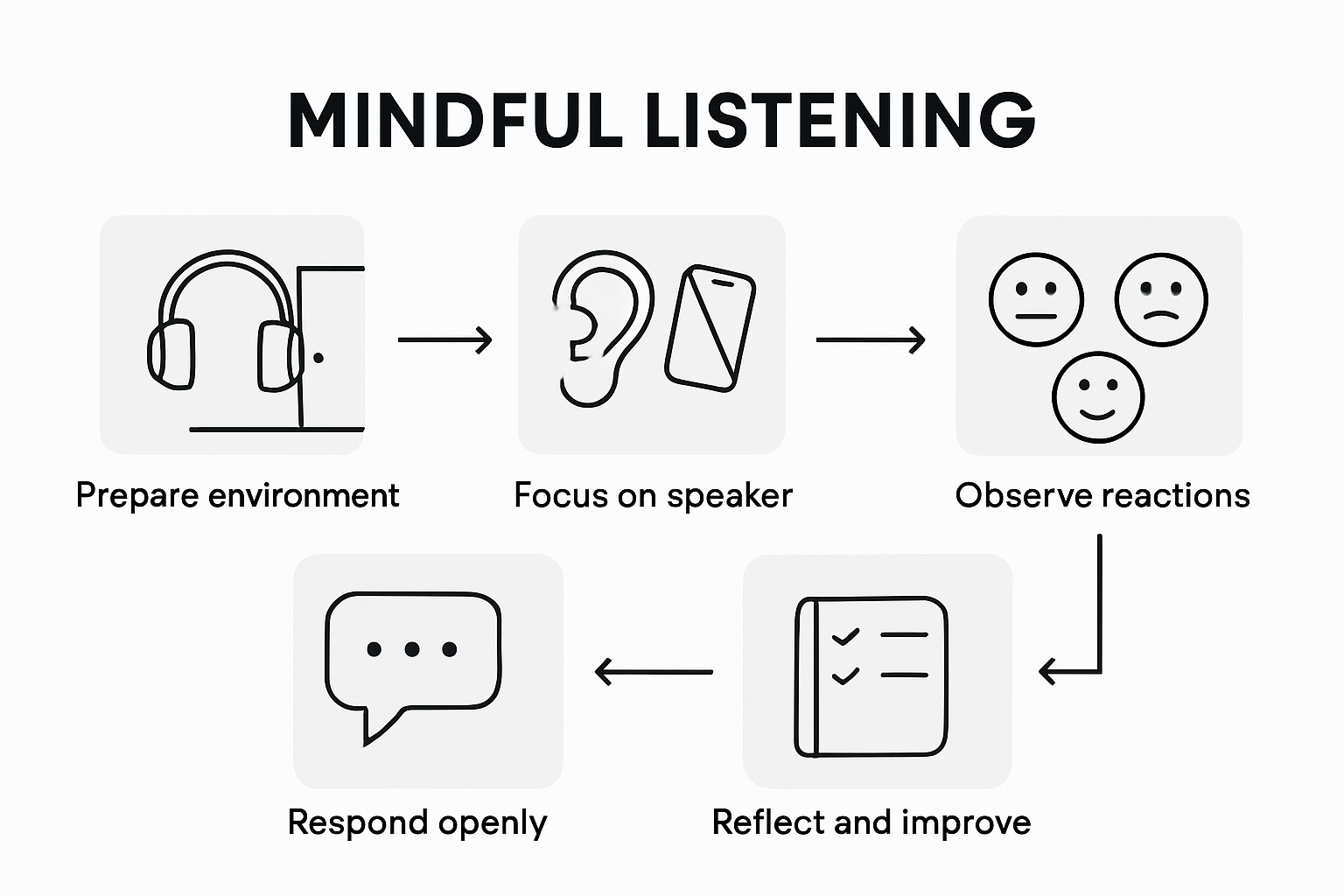
Consider keeping a brief journal to document your insights after significant conversations. Note the nonverbal cues you observed, the emotions you detected, and any moments where you felt yourself struggling to listen fully. This self reflection helps you identify patterns in your listening behavior and provides opportunities for continuous improvement. Pay attention to moments where you may have been reactive instead of receptive, and think about how you might approach similar situations differently in the future.
Pro tip: If you find recurring challenges in your listening practice, consider discussing them with a trusted friend or mentor. Sometimes an outside perspective can help you recognize blind spots and develop more nuanced communication skills that you might not see on your own.
Transform Your Communication Through Mindful Listening Today
Are you ready to overcome common barriers like distractions, misunderstandings, and emotional reactivity that often stand in the way of truly connecting with others? This article highlights key challenges such as maintaining present moment awareness, interpreting nonverbal cues, and responding thoughtfully. If you have found yourself struggling to stay fully engaged or wanting to deepen your relationships through mindful listening, you are not alone.

Discover personalized strategies and professional guidance with Monika Varela, psychologist and mindfulness coach. At Monika’s website, you can explore expert-led mindfulness workshops, tailored psychotherapy, and effective communication coaching designed to help you embody the principles of mindful listening. Take your next step toward clearer understanding and authentic connection by visiting Monika Varela’s homepage and start transforming your conversations today.
Frequently Asked Questions
How can I create a conducive environment for mindful listening?
Creating a conducive environment requires finding a quiet space with minimal distractions. Choose a comfortable setting, turn off electronic devices, and ensure your body language conveys openness, such as maintaining gentle eye contact and a relaxed posture.
What techniques can I use to maintain focus while someone is speaking?
To maintain focus, actively engage by nodding and practicing soft eye contact. If your mind starts to wander, redirect your attention by concentrating on the speaker’s tone or facial expressions to stay present in the conversation.
How do I acknowledge nonverbal cues during conversations?
Acknowledge nonverbal cues by closely observing the speaker’s body language and emotional reactions. Take note of changes in tone, facial expressions, and posture, and respond with curiosity to validate their feelings without judgment.
What is the best way to respond after listening mindfully?
Respond by pausing to reflect on what you have heard before crafting a thoughtful reply. Use validating phrases like “What I hear you saying is…” to show you have listened and understood their perspective.
How can I improve my mindful listening skills over time?
You can improve your mindful listening skills by regularly reflecting on your conversations and noting key insights in a journal. Set a goal to review your listening experiences weekly, which can help identify areas for growth and enhance your overall communication skills.
What should I do if I feel triggered during a conversation?
If you feel triggered, take a deep breath to pause and collect your thoughts before responding. This moment of reflection allows you to engage more thoughtfully and keep the conversation respectful and open.





Aún no hay comentarios, ¡añada su voz abajo!