


Every American spends thousands of hours communicating each year, but studies show that active listening accounts for less than half of that time. Listening skills shape every conversation, job interview, friendship, and relationship you have. Whether aiming for academic achievement or a stronger personal connection, understanding the true meaning of listening goes far beyond simply hearing words. Discover what sets skillful listening apart and how mastering it can transform the way you interact with the world.
Table of Contents
- Defining Listening Skills And Their Importance
- Different Types Of Listening Explained
- Core Components Of Effective Listening
- Personal And Professional Impact Of Skillful Listening
- Common Barriers And Pitfalls To Avoid
Key Takeaways
| Point | Details |
|---|---|
| Listening Skills are Essential | Effective listening enhances communication and interpersonal connections, vital for both academic success and professional growth. |
| Types of Listening | Recognizing different listening types—discriminative, comprehensive, critical, therapeutic, and appreciative—enables better adaptability in various contexts. |
| Continuous Practice is Key | Developing listening skills requires ongoing practice, including focused listening exercises and self-assessment of listening behaviors. |
| Overcoming Barriers | Being aware of common listening barriers like premature judgment and internal distractions enables more effective engagement in conversations. |
Defining Listening Skills and Their Importance
Listening skills are complex cognitive and interpersonal abilities that enable individuals to comprehend, process, and meaningfully engage with spoken communication. Far more than passive hearing, these skills require intentional focus, emotional intelligence, and strategic interpretation of verbal and nonverbal messages.
Research demonstrates the profound significance of listening capabilities. A comprehensive study investigating communication abilities highlights that active listening is essential for effective communication and academic excellence. These skills are not innate but learned competencies that can be systematically developed through practice and awareness.
Effective listening encompasses several critical components:
- Comprehension: Accurately understanding the literal meaning of spoken words
- Interpretation: Discerning underlying emotions, context, and implicit messages
- Retention: Remembering key information and details
- Responsive engagement: Providing thoughtful, relevant feedback
Moreover, communication research emphasizes that listening skills are crucial for academic success and professional advancement. They create bridges between individuals, facilitating deeper understanding, reducing misunderstandings, and fostering more meaningful interpersonal connections.
Pro Tip – Listening Practice: Spend 10 minutes daily practicing focused listening by engaging in conversations without interrupting, maintaining eye contact, and summarizing what you’ve heard to confirm comprehension.
Different Types of Listening Explained
Listening is not a monolithic skill but a complex set of approaches tailored to different communication contexts. Research exploring communication techniques reveals multiple distinct listening types, each serving unique purposes in personal and professional interactions.
Five primary listening categories emerge from communication research:
- Discriminative Listening: The foundational ability to recognize sounds, tone, and verbal nuances
- Comprehensive Listening: Understanding the complete meaning and context of communication
- Critical Listening: Analytically evaluating information, assessing credibility and underlying motivations
- Therapeutic Listening: Providing emotional support and creating safe spaces for expression
- Appreciative Listening: Deriving pleasure, inspiration, or motivation from the communication
Detailed communication studies further elaborate on these listening types, demonstrating how each requires specific cognitive and emotional skills. Comprehensive listening, for instance, demands complete attention and the ability to decode both verbal and nonverbal communication signals.
Understanding these listening types allows individuals to adapt their communication approach strategically, enhancing interpersonal effectiveness across various personal and professional scenarios.
Here’s a quick comparison of the primary types of listening and when each is most effective:
| Listening Type | Main Focus | Best Used In |
|---|---|---|
| Discriminative | Distinguishing tones and cues | Detecting sarcasm or emphasis |
| Comprehensive | Grasping full content and context | Learning new information |
| Critical | Evaluating facts and intentions | Debates, presentations |
| Therapeutic | Supporting emotional needs | Counseling, personal conversations |
| Appreciative | Enjoying language or delivery | Music, inspiring speeches |
Pro Tip – Listening Type Adaptation: Practice consciously switching between listening types during conversations, matching your approach to the speaker’s intent and emotional context.
Core Components of Effective Listening
Effective listening transcends simple auditory perception, representing a sophisticated cognitive and emotional process that demands intentional engagement. Research exploring communication dynamics reveals that successful listening involves active engagement, nuanced cognitive processing, and the ability to interpret both verbal and nonverbal communication signals.
The core components of effective listening can be strategically categorized into several critical dimensions:
- Cognitive Processing: Actively processing and interpreting incoming information
- Emotional Intelligence: Recognizing and understanding underlying emotional contexts
- Attention Management: Maintaining focused concentration during communication
- Nonverbal Interpretation: Decoding body language, tone, and subtle communication cues
- Empathetic Engagement: Creating a supportive and understanding communication environment
Academic communication studies underscore that effective listening is fundamental to meaningful interactions, contributing significantly to academic and professional success. This multifaceted skill requires continuous practice and self-awareness, enabling individuals to develop sophisticated communication capabilities.

Successful listeners demonstrate remarkable adaptability, seamlessly navigating complex communication landscapes by integrating cognitive, emotional, and interpretive skills. They transform listening from a passive activity into an active, dynamic process of understanding and connection.
Pro Tip – Listening Skill Enhancement: Regularly record and review your conversations, analyzing your listening patterns and identifying areas for improvement in real-world communication scenarios.
Personal and Professional Impact of Skillful Listening
Listening skills are transformative capabilities that extend far beyond mere communication, profoundly influencing both personal relationships and professional success. Research exploring communication effectiveness demonstrates that proficient listening is vital for building strong interpersonal connections and achieving academic and professional excellence.
In personal contexts, skillful listening creates deeper, more meaningful relationships by:
- Fostering emotional understanding
- Reducing misunderstandings
- Building trust and empathy
- Creating safe emotional spaces
- Demonstrating genuine care and respect
Professionally, advanced listening skills become critical differentiators. Individuals who master these skills typically experience:
- Enhanced leadership capabilities
- Improved team collaboration
- More effective conflict resolution
- Increased workplace productivity
- Better client and customer relationships
Innovative interaction studies further reveal how sophisticated listening techniques can dramatically improve communication dynamics, particularly in complex interpersonal and technological environments. The ability to actively listen transforms interactions from transactional exchanges to meaningful dialogues.
Ultimately, listening is not just about hearing words, but comprehending underlying emotions, intentions, and unspoken narratives. It represents a powerful tool for personal growth, professional advancement, and meaningful human connection.
The following table summarizes key impacts of skillful listening in personal and professional life:
| Domain | Positive Outcomes | Long-Term Benefit |
|---|---|---|
| Personal | Deeper relationships, stronger trust | Enhanced emotional resilience |
| Professional | Effective teams, greater productivity | Improved career advancement |
Pro Tip – Listening Impact Tracking: Maintain a weekly journal documenting how intentional listening has positively influenced your personal and professional interactions.
Common Barriers and Pitfalls to Avoid
Effective listening requires conscious effort and awareness of potential communication obstacles that can significantly impede understanding. Research investigating listening challenges highlights the complex nature of comprehension barriers that individuals frequently encounter.
Key barriers to effective listening include:
- Premature Judgment: Forming opinions before fully hearing the speaker’s complete message
- Internal Distractions: Mental preoccupations that prevent full cognitive engagement
- Emotional Reactivity: Allowing personal emotions to cloud objective understanding
- Selective Hearing: Focusing only on parts of the message that align with preexisting beliefs
- Technological Interruptions: Constant digital notifications fragmenting attention
Comprehensive communication studies reveal that listening challenges are not merely individual shortcomings but complex interactions between psychological, environmental, and technological factors. These barriers can manifest differently across personal and professional contexts, requiring adaptive strategies.
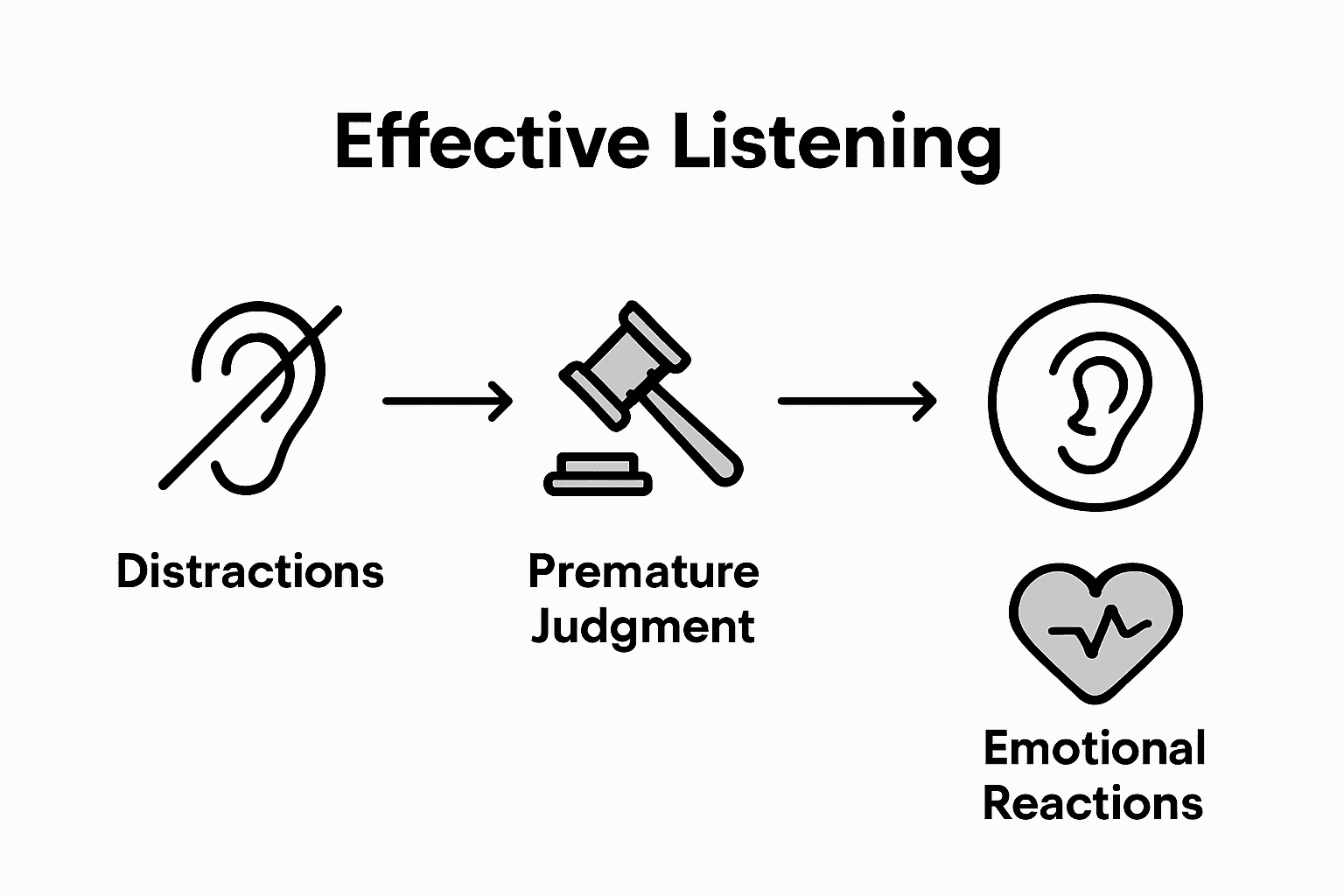
Understanding these obstacles is the first step in developing more sophisticated listening skills. Recognizing when these barriers emerge allows individuals to consciously redirect their attention, suspend judgment, and create more meaningful communication experiences.
Pro Tip – Barrier Awareness: Conduct a daily self-assessment of your listening behaviors, identifying specific moments where communication barriers emerged and reflecting on more effective response strategies.
Enhance Your Personal Growth Through Expert Listening Skills Development
Struggling to overcome common barriers like premature judgment or emotional reactivity while listening? This article highlights how mastering different types of listening and understanding their core components unlock profound personal growth and deeper relationships. If you are ready to transform your communication patterns and empower your emotional intelligence, professional guidance can make all the difference.

Discover tailored psychotherapy, mindfulness coaching, and communication training at Monikavarela.com where Monika Varela integrates psychological expertise with practical mindfulness techniques to boost your listening effectiveness. Don’t wait to cultivate empathetic engagement and clear attention management today. Start your journey toward enhanced personal and professional connections now by exploring these transformative services at Monikavarela.com and take the first step to meaningful change.
Frequently Asked Questions
What are listening skills and why are they important?
Listening skills are cognitive and interpersonal abilities that allow individuals to comprehend and engage with spoken communication. They are crucial for effective communication, emotional understanding, and building meaningful relationships.
How can I improve my listening skills for personal growth?
You can improve your listening skills by practicing focused listening, such as maintaining eye contact, summarizing what you’ve heard, and actively engaging in conversations without interrupting. Regular self-assessment can also aid in identifying areas for improvement.
What are the different types of listening and when should I use them?
There are several types of listening, including discriminative, comprehensive, critical, therapeutic, and appreciative. Each serves different purposes; for example, use comprehensive listening to understand new information and therapeutic listening when providing emotional support.
What are common barriers to effective listening?
Common barriers to effective listening include premature judgment, internal distractions, emotional reactivity, selective hearing, and technological interruptions. Being aware of these obstacles can help you develop strategies to overcome them.





Aún no hay comentarios, ¡añada su voz abajo!