


Over half of American professionals report that unclear communication causes daily frustration at work. Whether you are leading a team or building personal relationships, strong communication habits shape your success. By developing a better awareness of how you interact, identifying barriers, and practicing mindful listening, you can transform the way you connect with others and achieve real progress in your personal and professional life.
Table of Contents
- Step 1: Assess Current Communication Habits
- Step 2: Identify Barriers and Set Clear Goals
- Step 3: Practice Mindful Listening Techniques
- Step 4: Strengthen Verbal and Nonverbal Skills
- Step 5: Request Feedback and Monitor Progress
Quick Summary
| Key Point | Explanation |
|---|---|
| 1. Conduct a Personal Communication Audit | Assess your own communication style by evaluating listening habits, nonverbal cues, and patterns through self-reflection and feedback. |
| 2. Identify Specific Barriers and Set Goals | List communication challenges like anxiety or self-doubt and create measurable goals to overcome them, helping structure your improvement plan. |
| 3. Practice Mindful Listening | Enhance understanding by focusing on the speaker, reducing distractions, and confirming comprehension through reflective summaries. |
| 4. Align Verbal and Nonverbal Skills | Match your spoken words with body language and tone to convey authenticity, ensuring your nonverbal signals support your message. |
| 5. Regularly Request Feedback | Establish a feedback system to gather insights from trusted individuals, enabling tracking of progress and identification of areas for continuous improvement. |
Step 1: Assess Current Communication Habits
Self-awareness is the foundation of meaningful communication improvement. Before you can enhance your skills, you need an honest snapshot of how you currently interact with others. Identifying your unique communication style provides crucial insights into your strengths and potential areas for growth.
Start by conducting a thorough personal communication audit. Evaluate your listening habits, nonverbal signals, and conversational patterns through careful self reflection. Consider asking trusted friends or colleagues for candid feedback about your communication approach. Track specific interactions for a week, noting moments where conversations felt smooth or challenging. Pay attention to patterns like interrupting others, speaking too quickly, avoiding eye contact, or struggling to express complex thoughts clearly.
One powerful technique is recording yourself during conversations or meetings to analyze your communication objectively. Watch for verbal tics, filler words, body language, and emotional tone. This unfiltered view reveals communication habits you might unconsciously repeat. Remember that improvement starts with honest self assessment without judgment. Your goal is understanding your current communication style so you can strategically develop more effective interaction skills.
Step 2: Identify Barriers and Set Clear Goals
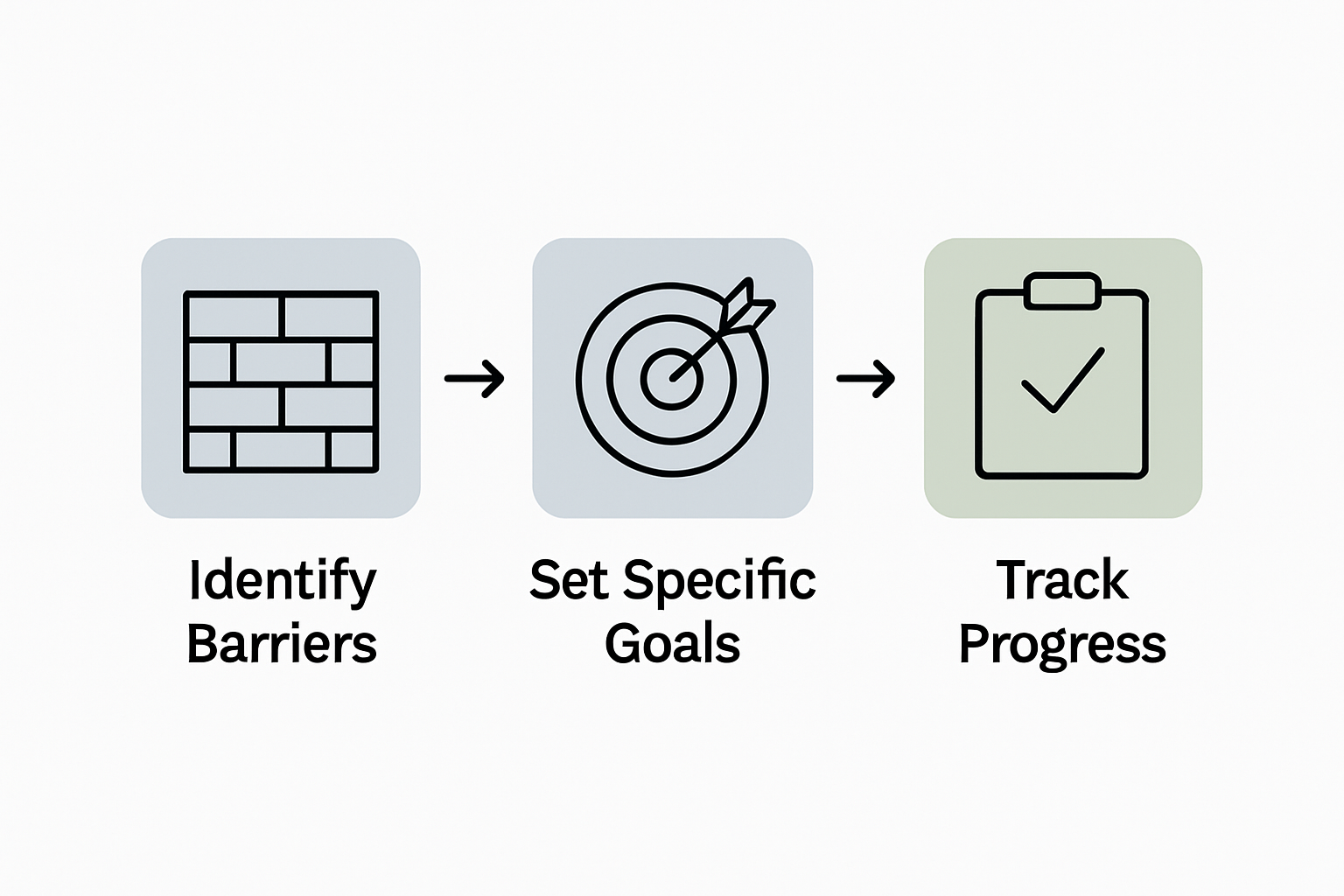
Understanding and overcoming communication obstacles is crucial for meaningful personal growth. This step helps you recognize the internal and external filters that might be blocking effective communication, allowing you to develop targeted strategies for improvement.
Begin by conducting an honest self assessment of your communication challenges. Seek support from trusted individuals who can provide objective feedback about your interaction patterns. Create a detailed list of specific communication barriers you experience such as anxiety during public speaking, difficulty expressing emotions, or struggling to maintain conversation balance. Categorize these barriers into internal challenges (like self doubt or fear) and external obstacles (such as language differences or environmental distractions).
Next, transform your identified barriers into concrete, measurable goals. Instead of vague aspirations like becoming a better communicator, set specific targets such as reducing verbal fillers by 50%, practicing active listening techniques for 15 minutes daily, or participating in one group discussion per week without experiencing social anxiety. Write these goals down and create a structured plan with clear milestones. Remember that progress is incremental tracking your improvements will help maintain motivation and provide tangible evidence of your communication skill development.
Step 3: Practice Mindful Listening Techniques
Mindful listening transforms communication from a passive exchange to an active, intentional connection. Understanding how to consider your audience and read nonverbal cues is fundamental to developing genuinely meaningful interactions that go beyond surface level conversation.
Start by creating a deliberate listening environment. Put away digital devices, make consistent eye contact, and position your body to show full engagement. Practice the 80/20 rule where you listen 80% of the time and speak only 20% of the time. When someone speaks, focus entirely on understanding their perspective without simultaneously preparing your response. Use body language that demonstrates active attention like occasional nodding, maintaining an open posture, and offering subtle verbal acknowledgments such as “I see” or “go on” to encourage continued sharing.

Develop a reflective listening technique where you periodically summarize what you have heard to confirm understanding. This approach not only validates the speaker’s experience but also ensures you are truly comprehending their message. For instance, after someone shares a complex thought, you might respond with “So what I hear you saying is…” and then briefly restate their key points. This method demonstrates respect, reduces miscommunication, and shows you are fully present in the conversation.
Step 4: Strengthen Verbal and Nonverbal Skills
Understanding the profound impact of body language is crucial to developing comprehensive communication skills. Effective communication goes far beyond words, involving a complex interplay of verbal expression and nonverbal signals that convey depth and authenticity.
Prepare strategically by considering your audience and practicing intentional communication techniques. Focus on aligning your verbal content with your physical gestures. Practice maintaining steady eye contact, using open body postures, and matching your facial expressions to your spoken message. Pay attention to your tone of voice, modulating pitch and volume to emphasize key points and demonstrate emotional intelligence. Record yourself during practice sessions to identify unconscious habits like nervous gestures, speaking too quickly, or monotone delivery.
Develop a feedback loop for continuous improvement. Seek input from trusted friends or colleagues about your communication style, asking specific questions about how your verbal and nonverbal signals are perceived. Work on eliminating filler words, practicing clear articulation, and creating a confident yet approachable communication presence. Remember that mastering communication is an ongoing journey of self awareness and deliberate practice.
Step 5: Request Feedback and Monitor Progress
Assessing communication skills requires a strategic approach that combines self reflection and external perspectives. Tracking your communication development is not about perfection but about understanding your growth trajectory and identifying areas for continuous improvement.
Design a comprehensive feedback collection process that includes multiple assessment methods. Start by creating a structured feedback template with specific questions about your verbal and nonverbal communication. Approach trusted colleagues, friends, and mentors who can provide honest and constructive observations. Request specific examples of when your communication was effective and moments where you could improve. Consider using anonymous survey tools to encourage candid responses, which can reveal insights you might not hear directly.
Establish a regular review cycle to monitor your progress. Create a communication skills journal where you document feedback, track your improvements, and reflect on your growth. Set measurable goals like reducing filler words, improving active listening, or increasing confidence in group discussions. Use digital tools or apps that can help you track communication metrics, and schedule quarterly self assessments to review your development. Remember that communication is a lifelong skill that requires consistent practice and an open mindset toward learning and adaptation.
Unlock Your True Potential Through Expert Communication Coaching
If you have ever struggled with barriers like anxiety, unclear expression, or active listening challenges this article’s insights can be your starting point for growth. At Monikavarela.com you will find personalized guidance from Monika Varela, a psychologist and mindfulness coach who specializes in transforming communication habits by blending mindfulness with proven psychological techniques. Explore how to overcome hurdles such as verbal fillers and misread nonverbal cues to build genuine personal and professional connections.
Take control of your communication journey now by visiting Monikavarela.com to book a session or discover programs tailored for mindful communication skill enhancement. Don’t wait to experience the confidence and clarity that come with mindful listening and effective verbal expression. Begin today and watch your relationships and career flourish through improved communication mastery.
Frequently Asked Questions
How can I assess my current communication habits?
To assess your current communication habits, conduct a personal communication audit. Track your interactions for a week and note instances where conversations felt smooth or challenging, paying attention to factors like interrupting or difficulty expressing thoughts clearly.
What barriers might I face in improving my communication skills?
Common barriers include anxiety while speaking, difficulty expressing emotions, or challenges with conversation balance. Identify these barriers by creating a list of specific communication obstacles and categorize them as internal (like self-doubt) or external (such as distractions).
What is mindful listening and how can I practice it?
Mindful listening is actively focusing on the speaker without distractions, emphasizing understanding. Create a distraction-free environment, apply the 80/20 rule by listening 80% of the time, and use reflective listening techniques to summarize and confirm understanding during conversations.
How can I strengthen my verbal and nonverbal communication skills?
To strengthen your skills, practice aligning your verbal messages with appropriate body language. Focus on maintaining eye contact, using open postures, and modulating your voice; continuously seek feedback to eliminate filler words and improve articulation.
How do I request feedback on my communication skills?
Request feedback by approaching friends, colleagues, or mentors with a structured template that includes specific questions about your communication style. Set a regular review cycle to reflect on their observations and document changes to track your progress over time.
What measurable goals should I set for improving my communication?
Set specific and measurable goals such as reducing filler words by 50% or practicing active listening techniques for 15 minutes every day. Write these goals down and create a plan with clear milestones to monitor your progress effectively.
Recommended
- Top 6 Communication Skills Coaching Tools – Expert Comparison 2025 – Mónika Varela
- Top Communication Skills Platforms – Expert Comparison 2025 – Mónika Varela
- Complete Guide to Why Develop Social Skills – Mónika Varela
- Communication Skills in Counseling: Complete Guide – Mónika Varela
- Visual Communication Skills: Complete Expert Guide – Projector Display
- Boost Your Sales Management Skills Now





Aún no hay comentarios, ¡añada su voz abajo!