


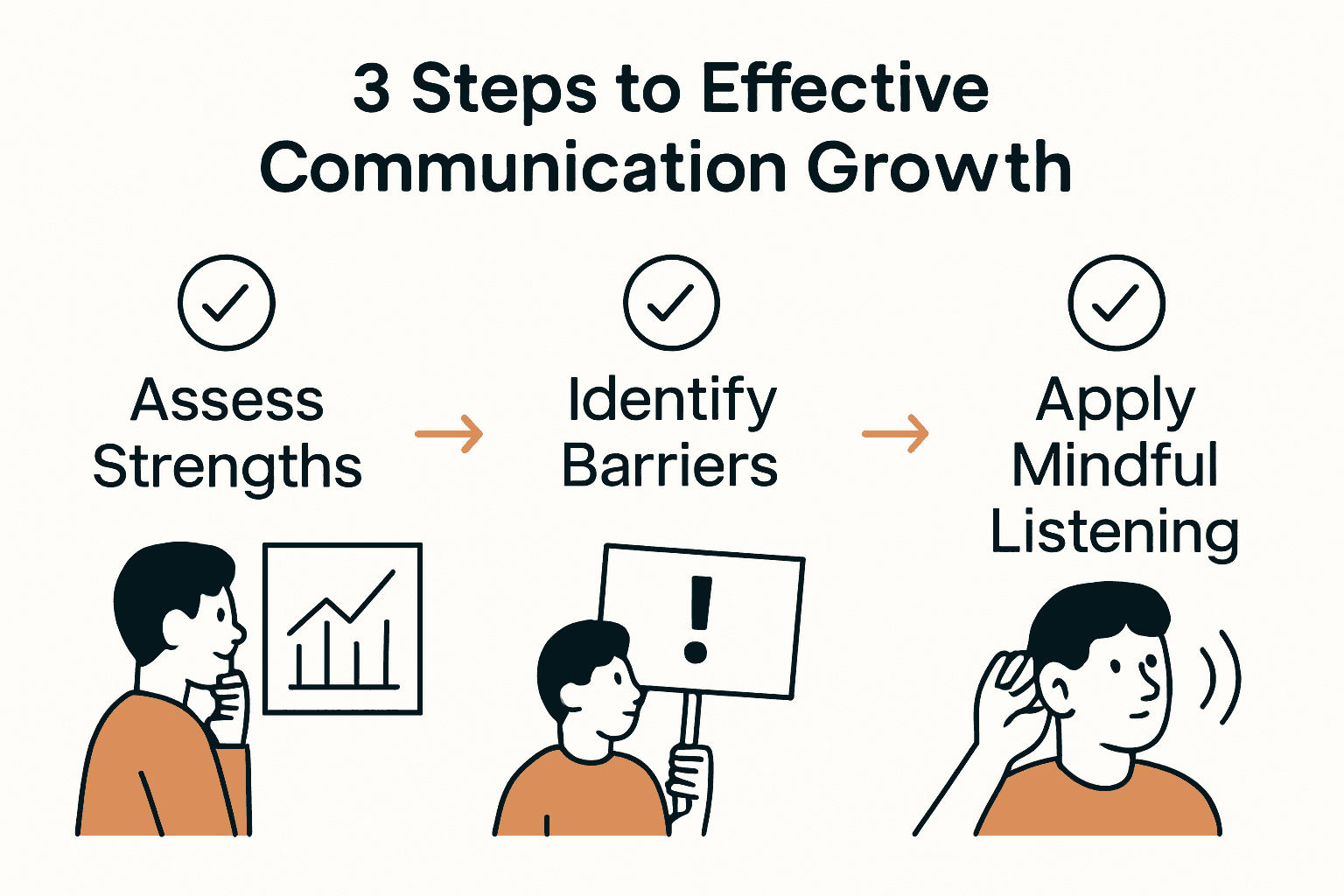
Nearly 70 percent of professionals believe that strong communication skills directly influence career growth. Yet many people never take time to evaluate their own habits or pinpoint hidden barriers. Building effective communication goes beyond talking—it means understanding your strengths, listening mindfully, and practicing clarity every day. This guide breaks down proven steps for anyone who wants to connect better at work, home, or in social circles.
Table of Contents
- Step 1: Assess Your Current Communication Strengths
- Step 2: Identify Your Communication Barriers
- Step 3: Apply Mindful Listening Techniques
- Step 4: Practice Clear And Assertive Expression
- Step 5: Review Interactions For Continuous Improvement
Quick Summary
| Key Point | Explanation |
|---|---|
| 1. Conduct an honest self-assessment | Assess your communication skills to identify strengths and areas for improvement through reflective questioning. |
| 2. Identify and track communication barriers | Document experiences of ineffective communication to uncover specific barriers like anxiety or defensiveness. |
| 3. Practice mindful listening techniques | Engage in active listening by being fully present and minimizing distractions during conversations. |
| 4. Use assertive communication strategies | Employ ‘I’ statements and confident body language to express thoughts clearly and respectfully. |
| 5. Regularly review communication interactions | Analyze significant conversations to learn from successes and challenges for continuous improvement. |
Step 1: Assess your current communication strengths
Knowing where you stand with communication skills is like having a personal roadmap for growth. According to SkillsYouNeed, self assessment is the critical first step toward meaningful improvement.
Start by conducting an honest personal inventory. Ask yourself key reflective questions about your communication patterns. How comfortable are you speaking in groups? Do you actively listen when others talk? Can you express complex ideas clearly? Do people seem engaged or distracted when you communicate?
A practical approach is creating a simple communication skills scorecard. Rate yourself from 1 to 5 in categories like active listening, clarity of expression, nonverbal communication, and emotional intelligence. MindTools recommends including perspectives from trusted colleagues or friends who can provide objective feedback about your communication style.
Pro Tip: Be brutally honest during your self assessment. Growth happens when you acknowledge areas needing improvement without judgment.
This initial assessment provides a baseline understanding of your current communication landscape.
 In the next step, we will transform these insights into actionable strategies for personal development.
Step 2: Identify your communication barriers
Understanding the obstacles that prevent clear communication is crucial for personal and professional growth. PubMed research reveals that communication barriers are complex and often deeply rooted in psychological and environmental factors.
Begin by conducting a frank self examination. Consider moments when your communication felt challenging or unsuccessful. Were you struggling with expressing your thoughts? Did you feel misunderstood? Typical communication barriers include emotional defensiveness, assumptions about others understanding, lack of active listening, anxiety about speaking, and cultural or language differences.
Create a personal communication barrier journal. For one week, document communication interactions that felt uncomfortable or ineffective. Note specific situations where you felt blocked or misunderstood. Track patterns such as:
- Feeling nervous in group discussions
- Difficulty expressing complex emotions
- Tendency to interrupt or not listen fully
- Avoiding difficult conversations
- Experiencing miscommunication in professional settings
Warning: Recognizing communication barriers requires radical self honesty. Be prepared to confront uncomfortable truths about your communication style.
This detailed exploration will help you pinpoint specific areas where communication skills need refinement.
In the next section, we will develop targeted strategies to overcome these identified barriers.
Step 3: Apply mindful listening techniques
Mindful listening transforms conversations from simple exchanges to meaningful connections. According to Mindful, this technique requires being fully present and reducing internal distractions that prevent genuine understanding.
SkillsYouNeed suggests practicing intentional listening through specific strategies. Start by creating physical and mental space for the conversation. Put away electronic devices. Make eye contact. Position your body to show openness and engagement. Resist the urge to interrupt or prepare your response while the other person speaks.
Implement a three step mindful listening approach:
- Receive: Focus completely on the speaker without judgment
- Appreciate: Understand the emotional context behind their words
- Respond: Reflect back what you heard to confirm understanding
Pro Tip: Practice breathing deeply and staying grounded during conversations. This helps maintain your attention and emotional neutrality.
By developing these mindful listening skills, you create deeper connections and more authentic communication.
 The next section will help you integrate these techniques into your daily interactions.
Step 4: Practice clear and assertive expression
Assertive communication is about expressing your thoughts and feelings confidently while respecting others. According to SkillsYouNeed, assertiveness strikes a balance between passive and aggressive communication styles.
MindTools recommends mastering the art of using ‘I’ statements to communicate effectively. Instead of saying ‘You always interrupt me,’ try ‘I feel frustrated when I am not able to complete my thoughts.’ This approach focuses on your experience without blaming or attacking the other person.
Develop your assertive communication toolkit with these key strategies:
- Maintain steady eye contact
- Use a calm and clear tone of voice
- Speak with confidence but without aggression
- Use body language that matches your words
- Practice saying ‘no’ without feeling guilty
Pro Tip: Start small. Practice assertive communication in low stakes situations to build your confidence gradually.
These techniques will help you communicate more authentically and respectfully. In the next section, we will explore how to adapt your communication style to different contexts and audiences.
Step 5: Review interactions for continuous improvement
Improving communication is an ongoing journey that requires regular self reflection and learning. SkillsYouNeed emphasizes the critical role of honest feedback in personal communication development.
Create a structured communication review process. After significant conversations or interactions take time to analyze what went well and what could be improved. Ask yourself reflective questions. Did you listen actively? Were you clear in expressing your thoughts? Did you notice any moments of misunderstanding or tension? Write down specific observations in your communication journal.
Develop a systematic approach to reviewing your communication performance:
- Immediately after important conversations record your impressions
- Identify specific moments where communication could have been more effective
- Note your emotional state and how it might have influenced the interaction
- Consider the perspectives of other participants
- Look for patterns in your communication challenges
Pro Tip: Be kind to yourself during this review process. Growth happens through compassionate self awareness not harsh self criticism.
By consistently reviewing and learning from your communication experiences you will gradually develop more nuanced and effective interaction skills. Your commitment to continuous improvement will transform your ability to connect meaningfully with others.
Unlock Your True Potential with Expert Communication Guidance
Struggling with barriers to clear and confident communication can hold back your personal and professional growth. This guide has shown how important mindful listening, assertive expression, and honest self-assessment are for meaningful change. If you are ready to overcome challenges like nervousness, misunderstood messages, or ineffective conversations, personalized support can accelerate your progress.
Discover how Monika Varela combines psychological expertise and mindfulness coaching to help you develop authentic communication skills. Whether through psychotherapy, tailored workshops, or coaching sessions, you can build confidence and connect with others more deeply. Start your transformation today by exploring her mindfulness workshops and private coaching options. Don’t wait to turn your communication struggles into strengths — take action now at Monika Varela.
Frequently Asked Questions
How can I assess my current communication strengths?
Start by conducting an honest self-assessment of your communication skills. Use a scorecard to rate yourself in areas like active listening and clarity, and seek feedback from trusted colleagues to identify strengths and areas for improvement.
What are common barriers to effective communication, and how can I identify them?
Common barriers include emotional defensiveness and difficulty expressing complex thoughts. Keep a communication barrier journal for one week to document situations where you felt blocked or misunderstood, helping you to recognize patterns in your communication style.
What techniques can improve my mindful listening skills?
Practice mindful listening by being fully present in conversations. Set aside distractions, maintain eye contact, and apply a three-step approach: Receive, Appreciate, and Respond to enhance your understanding of the speaker’s message.
How can I practice assertive expression in my communications?
Use ‘I’ statements to express thoughts confidently while respecting others. Start by practicing in low-stakes situations, focusing on maintaining steady eye contact and a calm tone to build your assertiveness over time.
What should I include in my communication review process?
After significant conversations, take time to analyze what went well and what didn’t. Write down your reflections, noting specific moments that could have been improved, to identify patterns in your communication challenges for future growth.
How can I ensure continuous improvement in my communication skills?
Commit to regular self-reflection by reviewing your interactions and seeking feedback. Aim to document insights after important conversations, and track your emotional state and the dynamics of those interactions to foster ongoing development.
Recommended
- 7 Essential Types of Communication Skills for Growth – Mónika Varela
- 7 Steps to Effective Communication Skills Checklist – Mónika Varela
- Why Join Mindfulness Workshops: The Definitive Guide – Mónika Varela
- 7 Essential Sales Team Training Topics for Growth – Ahead of Sales
- Growth Hacking Fundamentals: Boost Results for Marketers





Aún no hay comentarios, ¡añada su voz abajo!