




Most teams underestimate how deeply empathy shapes workplace success. Studies reveal that over 40 percent of American employees believe poor empathy at work increases stress and conflict. For HR professionals and team leaders, grasping empathy’s complexities matters even more in multicultural settings, especially when aiming to support collaboration and mental well-being. This article breaks down common misconceptions about empathy while sharing practical methods that help teams everywhere—American or otherwise—build emotional intelligence for stronger, healthier connections.
Table of Contents
- Defining Empathy and Its Misconceptions
- Types of Empathy in Team Settings
- How Empathy Improves Team Communication
- Empathy’s Impact on Conflict Resolution
- Practical Strategies to Foster Team Empathy
Key Takeaways
| Point | Details |
|---|---|
| Empathy is a Developable Skill | Empathy is not a fixed trait but a dynamic skill that can be cultivated through practice. Intentional efforts can enhance both cognitive and affective empathy in individuals. |
| Types of Empathy in Teams Matter | Understanding different types of empathy—cognitive, emotional, and compassionate—can improve team dynamics and foster collaboration. Each type plays a unique role in enhancing interpersonal relationships. |
| Empathetic Communication Drives Innovation | Prioritizing empathetic communication creates psychological safety, encouraging team members to share ideas and admit mistakes, which can lead to greater organizational resilience. |
| Structured Practices Foster Empathy | Implementing strategies such as role-playing and emotional check-ins within teams can nurture a culture of empathy, enhancing mutual understanding and trust among members. |
Defining Empathy and Its Misconceptions
Empathy is a complex psychological construct that goes far beyond simple emotional understanding. Recent research highlights the contextual nature of empathy and reveals two primary dimensions: cognitive empathy and affective empathy. These nuanced components represent distinct yet interconnected ways humans relate to one another’s emotional experiences.
Cognitive empathy involves intellectually understanding another person’s emotional state, while affective empathy centers on experiencing and expressing appropriate emotional responses. Contrary to popular belief, empathy is not a fixed trait but a dynamic skill that can be developed and refined through intentional practice. Professional literature reveals significant variation in how empathy is conceptualized , with researchers identifying at least 43 different definitions across clinical and psychological domains.
Common misconceptions about empathy often lead professionals to misunderstand its true nature. Many people incorrectly assume empathy is purely an innate characteristic, when in fact it represents a complex interaction between individual disposition and situational context. Some believe empathy means agreeing with another person’s perspective, but it actually involves deeply understanding their emotional experience without necessarily endorsing their specific viewpoint.
Pro tip: Practice active listening by focusing entirely on understanding the speaker’s perspective without preparing your response, which helps develop more genuine empathetic connections.
Types of Empathy in Team Settings
Empathetic interactions in team environments are complex and multifaceted, encompassing several distinct yet interconnected approaches. Research highlights the dynamic nature of empathy in organizational contexts, revealing that empathy is not a static trait but a fluid skill influenced by situational factors and individual capabilities.
Systematic literature reviews have identified multiple empathy types critical in workplace settings, which can be broadly categorized into three primary dimensions: cognitive empathy, emotional empathy, and compassionate empathy. Cognitive empathy involves intellectually understanding team members’ perspectives, emotional empathy centers on feeling what others are experiencing, and compassionate empathy combines understanding with a genuine desire to support and help.
Each empathy type plays a unique role in team dynamics. Cognitive empathy allows team members to understand different viewpoints and communication styles, emotional empathy helps build deeper connections and trust, and compassionate empathy drives collaborative problem solving and mutual support. Understanding these nuanced differences enables teams to develop more sophisticated and responsive interpersonal strategies.

Here’s how the three main types of empathy function and their roles in teams:
| Empathy Type | Key Function | Typical Outcome in Teams | Example Scenario |
|---|---|---|---|
| Cognitive | Understand others’ perspectives | Improved collaboration | Recognizing why a teammate is frustrated |
| Emotional | Feel others’ emotions | Stronger trust | Sensing a teammate’s anxiety before a deadline |
| Compassionate | Combine understanding with action | Increased mutual support | Offering help after noticing a colleague’s stress |
Pro tip: Practice rotating leadership roles during team projects to help members develop different empathy perspectives and enhance overall team emotional intelligence.
How Empathy Enhances Team Communication
Team communication fundamentally transforms when empathy becomes a core organizational skill. Practices such as active listening and emotional recognition build stronger workplace communities, creating an environment where team members feel genuinely heard and understood. This approach goes beyond simple conversation, establishing a profound connection that enables more authentic and productive interactions.
Effective empathetic communication involves several critical components. Team members must learn to suspend judgment, practice deep listening, and validate others’ emotional experiences without immediately offering solutions. This means creating space for colleagues to express themselves fully, acknowledging their perspectives, and demonstrating genuine curiosity about their thoughts and feelings. By prioritizing understanding over immediate problem solving, teams can develop more nuanced and supportive communication strategies.
The impact of empathetic communication extends far beyond interpersonal dynamics. When teams consistently practice empathy, they create psychological safety that allows for more innovative thinking, transparent dialogue, and collaborative problem solving. Employees feel more comfortable sharing challenging ideas, admitting mistakes, and seeking help, which ultimately drives organizational resilience and adaptability. By recognizing and honoring each team member’s unique emotional landscape, organizations can unlock unprecedented levels of collective intelligence and creative potential.
Pro tip: Implement monthly “listening circles” where team members take turns sharing professional challenges without interruption, practicing deep empathetic listening and mutual support.
Empathy’s Impact on Conflict Resolution
Conflict resolution transforms dramatically when empathy becomes the primary lens through which disagreements are viewed. Empathic mediation involves fostering understanding between disputing parties by creating collaborative pathways, moving beyond transactional agreements to deeper relational repair. This approach recognizes that most workplace conflicts stem from unaddressed emotional undercurrents rather than surface-level disagreements.
Effective conflict resolution skills require sophisticated emotional intelligence that goes beyond simple communication techniques, emphasizing understanding cultural differences and building trust. When team members learn to approach conflicts with genuine curiosity about others’ perspectives, they create psychological safety that transforms potential confrontations into opportunities for mutual growth. This means actively listening without judgment, validating emotional experiences, and seeking to understand the underlying needs and concerns driving each party’s position.
The strategic application of empathy in conflict resolution involves several critical skills. These include suspending immediate defensiveness, practicing reflective listening, acknowledging emotional experiences, and reframing conflicts as shared challenges to be solved collaboratively. By shifting from a combative mindset to a collaborative one, teams can turn potentially destructive disagreements into moments of organizational learning and relationship strengthening. Empathy allows individuals to see beyond their immediate perspective, recognize shared goals, and find creative solutions that honor everyone’s fundamental dignity and contributions.
Pro tip: Develop a team conflict resolution protocol that requires each party to first articulate the other’s perspective accurately before presenting their own position, ensuring mutual understanding.
Practical Strategies to Foster Team Empathy
Empathy development requires intentional practice and structured approaches within team environments. Practical strategies for building empathetic cultures involve creating deliberate opportunities for perspective-taking and emotional connection, transforming how team members understand and interact with one another. These strategies go beyond simple communication exercises, requiring genuine commitment to understanding diverse emotional landscapes.
Effective empathy-building techniques include structured activities that challenge team members to step outside their typical communication patterns. These might involve role-playing exercises where individuals represent perspectives different from their own, implementing regular emotional check-ins that create space for vulnerability, and developing communication protocols that prioritize listening over immediate problem solving. By creating systematic approaches to emotional intelligence, teams can gradually build a culture of mutual understanding and respect.
The most successful empathy strategies integrate both individual and collective development. This means providing personal development resources like emotional intelligence training, creating team rituals that celebrate diverse perspectives, and establishing feedback mechanisms that reward empathetic behaviors. Organizations must also recognize that empathy is not a one-time achievement but a continuous process of learning, adapting, and growing together. By embedding empathy into performance expectations, communication guidelines, and team values, leaders can create environments where emotional intelligence becomes a core organizational competency.
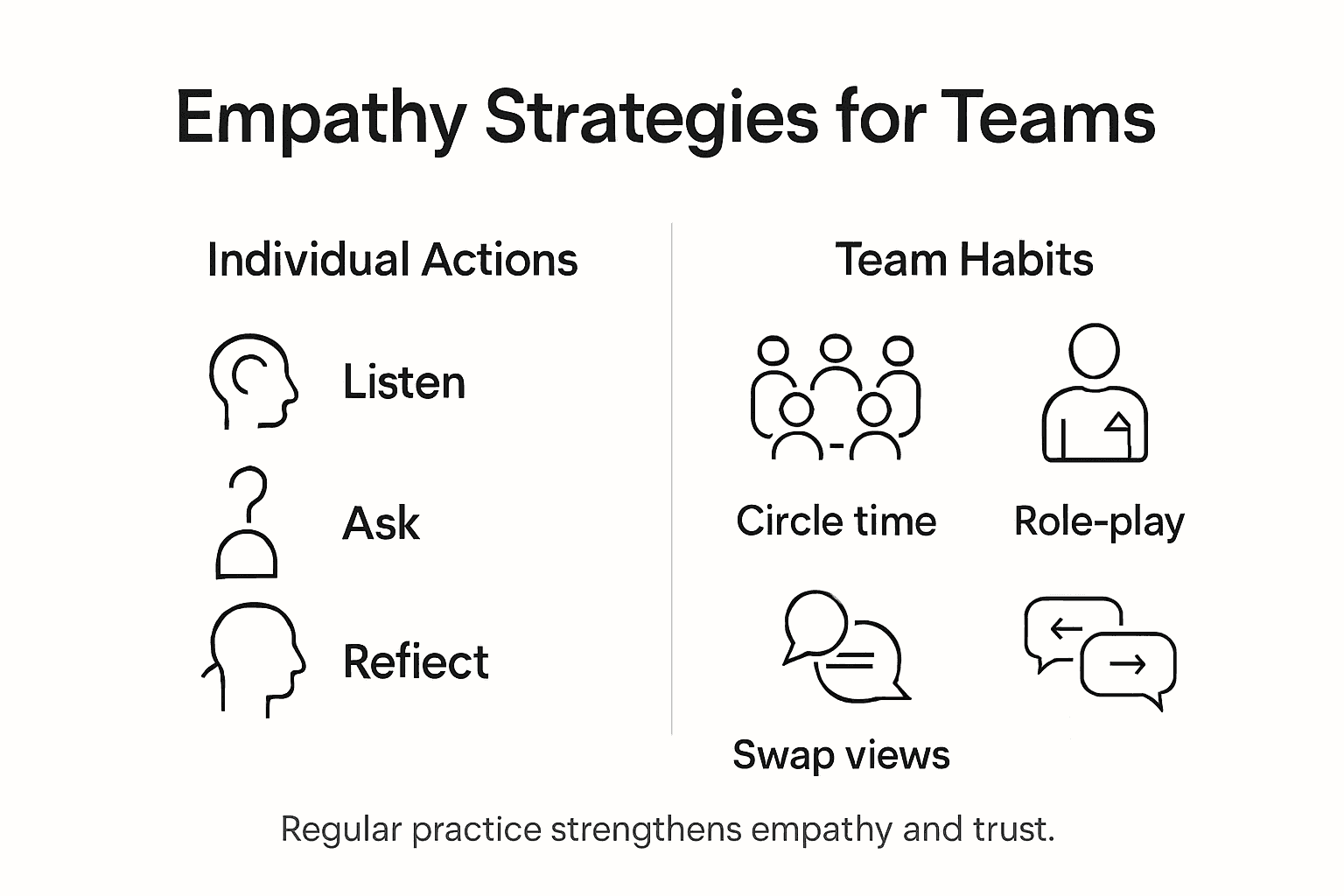
The following table summarizes effective strategies for cultivating team empathy:
| Strategy | Purpose | How It Enhances Empathy |
|---|---|---|
| Role-play exercises | Perspective-taking | Expands awareness of others’ viewpoints |
| Emotional check-ins | Build trust | Encourages openness and vulnerability |
| Communication protocols | Structure dialogue | Prioritizes understanding before problem solving |
| Feedback mechanisms | Reinforce behavior | Rewards empathetic interactions over time |
Pro tip: Implement monthly “perspective swap” sessions where team members present challenges from a colleague’s viewpoint, practicing deep empathetic understanding and broadening collective awareness.
Unlock the Power of Empathy to Transform Your Team Collaboration
Building on the insightful exploration of empathy’s role in teams, it is clear that mastering cognitive, emotional, and compassionate empathy is key to overcoming communication barriers and resolving conflicts effectively. If your team struggles with misunderstandings, trust issues, or lacks mutually supportive connections, focused development of empathetic skills can create lasting change. The practical strategies highlighted in the article, such as active listening and structured perspective-taking, are exactly the types of skills nurtured through professional guidance.
Discover how Monika Varela’s expert psychotherapy and corporate training programs at Monikavarela.com can empower your team to foster genuine emotional intelligence and enhance collaboration. Whether you seek personalized mindfulness coaching, communication skill workshops, or conflict resolution facilitation, Monika’s inclusive approach supports diverse teams and individuals. Start evolving your team culture today with tailored strategies proven to deepen empathy and drive better workplace outcomes. Visit Monikavarela.com now and take the first step toward transformational team communication.
Frequently Asked Questions
What is the difference between cognitive, emotional, and compassionate empathy in team settings?
Cognitive empathy involves understanding others’ perspectives, emotional empathy focuses on feeling what others are experiencing, and compassionate empathy combines both understanding and a desire to help.
How can empathy improve team communication?
Empathy enhances team communication by fostering a genuine connection where team members feel heard and validated, leading to more productive and open dialogues.
What strategies can teams use to cultivate empathy?
Teams can cultivate empathy through role-playing exercises, emotional check-ins, structured communication protocols, and feedback mechanisms that reinforce empathetic behaviors.
How does empathy contribute to conflict resolution in teams?
Empathy allows team members to approach conflicts with curiosity, transforming confrontations into opportunities for growth by validating emotional experiences and fostering collaborative solutions.





Aún no hay comentarios, ¡añada su voz abajo!