


Most people think public speaking is only for natural-born extroverts, yet research shows that anyone can learn these skills with practice. Nearly 75 percent of adults report feeling nervous about speaking in front of others, making it one of the most common social fears. Public speaking impacts every aspect of life, from career growth to personal relationships, so learning what this skill really involves—and cutting through the myths—can make all the difference for your confidence and success.
Table of Contents
- Defining Public Speaking Skills And Misconceptions
- Types Of Public Speaking And Contexts
- Key Elements And Techniques Of Effective Speaking
- Impact On Personal And Professional Success
- Common Mistakes And Barriers To Avoid
Key Takeaways
| Point | Details |
|---|---|
| Public speaking is a learnable skill | Many believe public speaking is an innate ability, but it can be developed through practice and training. |
| Nonverbal communication is crucial | Effective public speaking requires mastering both verbal and nonverbal techniques, including body language and emotional engagement. |
| Diverse contexts enhance adaptability | Understanding various public speaking types and contexts allows individuals to tailor their communication strategies effectively. |
| Mistakes can hinder effectiveness | Common pitfalls, such as inconsistent body language and excessive nervousness, can undermine communication and should be actively addressed. |
Defining Public Speaking Skills and Misconceptions
Public speaking represents far more than simply standing in front of an audience and delivering a prepared speech. According to Wikipedia, public speaking involves delivering speeches to live audiences with the primary goals of informing, persuading, or entertaining. These presentations span diverse contexts, from political debates to ceremonial addresses, each requiring nuanced communication strategies.
Contrary to popular belief, public speaking skills are not limited to formal presentations. They encompass a sophisticated range of verbal and nonverbal communication techniques that apply in numerous professional and personal scenarios. As research from arXiv indicates, effective public speaking demands a complex skill set that extends beyond verbal communication, emphasizing the critical role of nonverbal behaviors in presentation competence.
Key misconceptions about public speaking often prevent individuals from developing their communication abilities. Many people mistakenly believe that public speaking is an innate talent rather than a learnable skill. In reality, these abilities can be systematically developed through targeted practice and strategic training. The most successful communicators understand that public speaking involves:
- Crafting clear, compelling narratives
- Managing personal anxiety and emotional responses
- Reading and responding to audience engagement
- Adapting communication style to different contexts
- Developing confident body language and vocal techniques
By recognizing public speaking as a multifaceted skill set rather than a singular performance ability, professionals can approach communication with greater confidence and strategic intentionality. The journey to becoming an exceptional communicator begins with understanding these fundamental principles and committing to continuous improvement.
Types of Public Speaking and Contexts
Public speaking is a dynamic and multifaceted discipline with numerous specialized forms and applications. According to Panchayat, public speaking encompasses a wide range of types, each serving unique purposes across different professional and personal contexts. These forms include informative speaking, persuasive presentations, entertaining speeches, demonstrative talks, and more specialized formats like group discussions and academic lectures.
One particularly intriguing style of public speaking is extemporaneous speaking, which represents a nuanced approach to communication. As explained by Wikipedia, this method involves careful preparation coupled with a spontaneous delivery style. Speakers prepare their content thoroughly but avoid memorization, instead using notes to guide a conversational and natural presentation. This approach allows for greater flexibility and authenticity compared to rigidly scripted speeches.

Public speaking contexts can be broadly categorized into several key domains:
- Educational Settings: Classroom lectures, academic presentations, student debates
- Professional Environments: Corporate meetings, conference presentations, training workshops
- Public Forums: Political speeches, community gatherings, motivational talks
- Competitive Platforms: Debate competitions, Toastmasters sessions, speech tournaments
- Personal Development: Networking events, professional development seminars
Understanding these diverse types and contexts helps individuals develop targeted communication strategies. By recognizing that public speaking is not a monolithic skill but a rich tapestry of communication techniques, professionals can adapt their approach to suit specific audiences and objectives. The key is to remain flexible, continuously learn, and view each speaking opportunity as a chance for personal and professional growth.
Key Elements and Techniques of Effective Speaking
Effective public speaking is a sophisticated blend of verbal and nonverbal communication strategies that go far beyond simply delivering words. Research from arXiv highlights the critical importance of understanding both speech factors and their collective contribution to overall communication effectiveness. Speakers must master a complex interplay of elements that transform ordinary talking into compelling, impactful communication.
Nonverbal communication plays an equally crucial role in public speaking. According to arXiv, effective speaking requires seamlessly integrating multiple communication channels. This means carefully aligning verbal aspects like pitch, loudness, and pacing with nonverbal cues such as facial expressions, gestures, and body posture. The most powerful speakers understand that their physical presence communicates as much as their words.
Key techniques for mastering public speaking include:
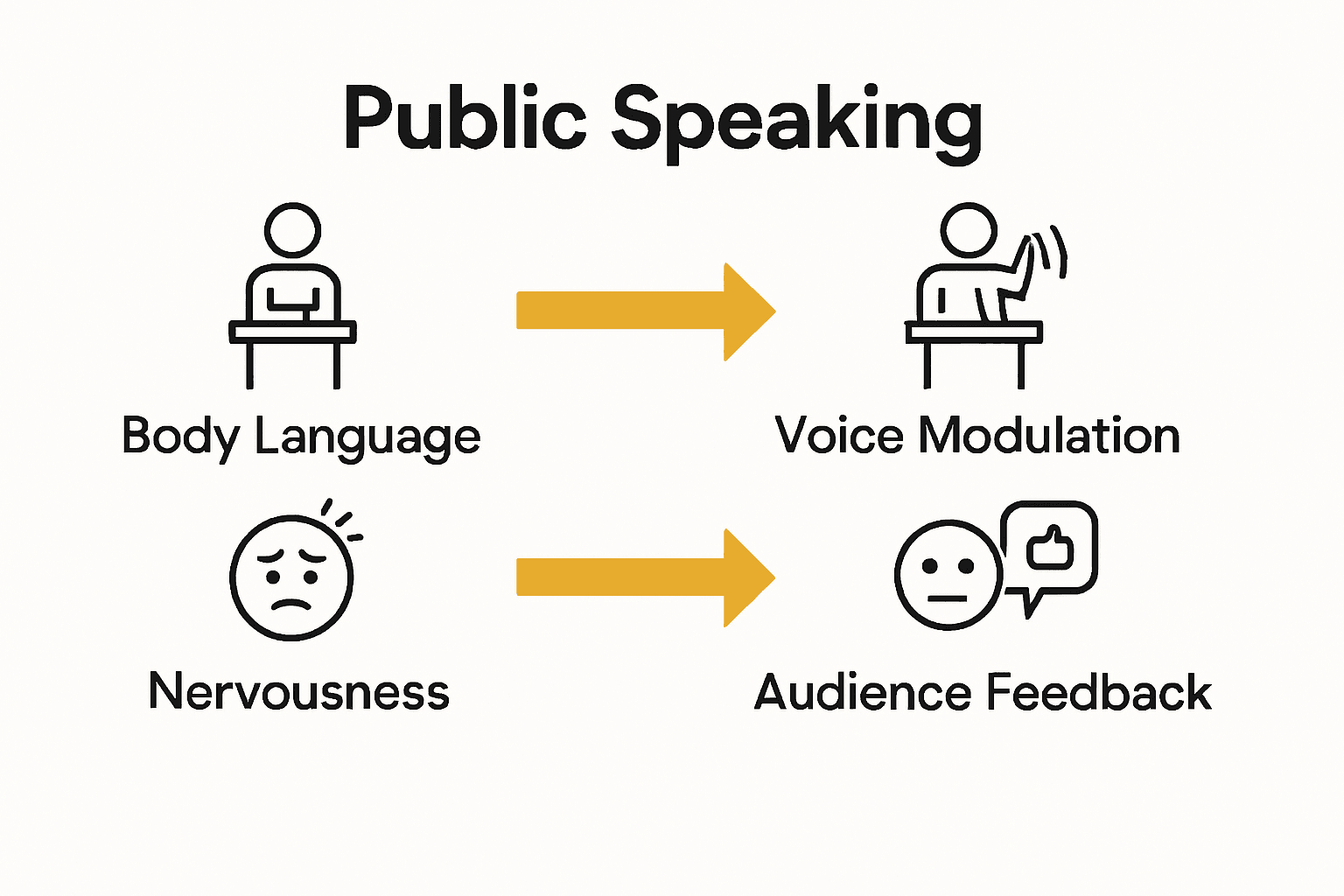
- Voice Modulation: Varying tone, speed, and volume to maintain audience engagement
- Emotional Intelligence: Reading and responding to audience reactions
- Storytelling: Creating narrative structures that connect emotionally
- Body Language Management: Using gestures and posture to reinforce message
- Strategic Pausing: Creating emphasis and allowing information to resonate
Ultimately, effective public speaking is an art form that requires continuous practice and self-awareness. By treating communication as a holistic experience that involves both mental preparation and physical execution, speakers can transform their ability to connect, persuade, and inspire audiences across various contexts and environments.
Impact on Personal and Professional Success
Public speaking skills are far more than a simple academic exercise—they are a critical determinant of personal and professional advancement. According to research from arXiv, presentation competence plays an essential role in social interactions across educational, professional, and everyday contexts. The ability to communicate effectively can significantly influence one’s opportunities and trajectory in life.
Professional environments particularly value strong communication abilities. As highlighted by arXiv, proficiency in public speaking is crucial for professionals to effectively communicate complex knowledge to diverse stakeholders. Engineers, managers, researchers, and leaders who can articulate their ideas clearly and confidently are more likely to gain recognition, lead projects, and advance in their careers.
The impacts of robust public speaking skills extend across multiple domains:
- Career Advancement: Increased visibility and leadership opportunities
- Networking: Better connections and relationship-building capabilities
- Personal Confidence: Enhanced self-assurance in social and professional settings
- Persuasion: Improved ability to influence and inspire others
- Problem-solving: More effective communication of complex ideas
Beyond tangible professional benefits, mastering public speaking transforms personal interactions. It empowers individuals to express themselves authentically, navigate challenging conversations, and build meaningful connections. The journey of becoming an exceptional communicator is not just about speaking—it’s about connecting, understanding, and ultimately, growing as a human being.
Common Mistakes and Barriers to Avoid
Public speaking can be a minefield of potential pitfalls that can undermine even the most well-intentioned communication efforts. According to research from arXiv, one of the most critical common mistakes involves neglecting nonverbal behaviors, which can significantly lead to miscommunication and diminish the speaker’s overall effectiveness.
Research further indicates that a major barrier in public speaking is the misalignment between verbal content and nonverbal communication. As highlighted by arXiv, speakers often struggle to ensure coherence between what they’re saying and how they’re physically presenting that information. This disconnect can create confusion, reduce credibility, and prevent the audience from fully engaging with the message.
Key mistakes and barriers to avoid include:
- Inconsistent Body Language: Gestures that contradict spoken words
- Excessive Nervousness: Allowing anxiety to overwhelm presentation delivery
- Lack of Preparation: Insufficient research or understanding of the topic
- Poor Voice Modulation: Monotone speaking that fails to maintain audience interest
- Ignoring Audience Feedback: Not reading or responding to audience reactions
- Over-reliance on Notes: Reading directly from slides or scripts
- Inappropriate Pacing: Speaking too quickly or too slowly
Overcoming these barriers requires a combination of self-awareness, consistent practice, and a willingness to seek feedback. Successful speakers understand that public speaking is a skill that can be developed and refined over time. By recognizing potential pitfalls and actively working to address them, individuals can transform their communication challenges into opportunities for growth and connection.
Elevate Your Public Speaking with Expert Guidance
Struggling with nervousness, unclear messaging, or inconsistent body language can hold you back from becoming the confident speaker you aspire to be. This article highlights how public speaking is a skill shaped by practice, emotional intelligence, and mastering vocal and nonverbal techniques. If you recognize the challenges of managing anxiety or delivering authentic speeches that truly engage your audience you are not alone.

Take the next step toward transforming your communication skills by exploring personalized coaching and mindfulness strategies at Monika Varela’s website. With her expertise as a psychologist and mindfulness coach, you can overcome common barriers like over-reliance on notes and inconsistent body language. Start building your presentation confidence and enhance your impact in professional and personal settings today by visiting https://monikavarela.com and discovering tailored public speaking coaching, mindfulness workshops, and corporate training designed to support your growth.
Frequently Asked Questions
What are the key elements of effective public speaking?
Effective public speaking involves a combination of voice modulation, emotional intelligence, storytelling, body language management, and strategic pausing. These elements work together to engage the audience and convey the message clearly.
How can I manage anxiety during public speaking?
Managing anxiety in public speaking involves understanding your emotional responses, practicing relaxation techniques, preparing thoroughly, and reframing nervousness as excitement. Continuous practice also helps build confidence over time.
What types of public speaking are there?
Public speaking encompasses various types, including informative speaking, persuasive presentations, entertaining speeches, demonstrative talks, and extemporaneous speaking, each serving different purposes in diverse contexts.
How can strong public speaking skills impact my career?
Strong public speaking skills can lead to increased career advancement opportunities, improved networking abilities, enhanced personal confidence, and greater effectiveness in problem-solving and persuasion, ultimately enriching your professional and personal interactions.





Aún no hay comentarios, ¡añada su voz abajo!