


Most American adults believe they know themselves well, yet studies show nearly 60 percent misjudge their own strengths and emotions. Self-awareness is more than a passing trend in personal development for Americans; it has become a pillar for healthier relationships, better decisions, and authentic self-growth. If you want to understand what self-awareness truly means and how it shapes every aspect of your life, you are in the right place to discover proven insights and practical strategies.
Table of Contents
- What Self-Awareness Really Means
- Types of Self-Awareness and Their Impact
- How Self-Awareness Drives Effective Change
- Real-World Benefits for Work and Wellbeing
- Common Barriers and How to Overcome Them
Key Takeaways
| Point | Details |
|---|---|
| Understanding Self-Awareness | Self-awareness encompasses recognizing one’s unique emotional landscape and internal experiences, requiring intentional practice and reflection. |
| Types of Self-Awareness | Reflective, social, and emotional self-awareness serve distinct roles in personal growth and effective communication. |
| Catalyst for Change | Developing self-awareness allows individuals to make thoughtful choices and align actions with core values, fostering personal transformation. |
| Overcoming Barriers | Addressing fear of vulnerability and cognitive biases is essential for genuine self-reflection and overcoming obstacles to self-awareness. |
What Self-Awareness Really Means
Understanding self-awareness goes far beyond simple introspection. At its core, self-awareness represents the profound capacity to recognize oneself as a distinct individual with unique emotional landscapes, behaviors, and internal experiences. Self-awareness is fundamentally the capacity for introspection and recognition of oneself as separate from the environment and others.
This complex psychological construct involves multiple dimensions. Emotional self-awareness encompasses knowledge of one’s emotional states, strengths, limitations, and preferences. It’s not just about knowing what you feel, but understanding why you feel it, how those emotions interconnect with your thoughts, and how they ultimately drive your actions.
Self-awareness requires intentional practice and honest self-reflection. It means developing the skill to observe your inner experiences without judgment, recognizing patterns in your behavior, and understanding the underlying motivations that shape your decisions. This isn’t about criticizing yourself, but about gaining a compassionate and objective understanding of your inner world.
The journey of self-awareness involves continuous learning and growth. By consistently examining your thoughts, emotions, and reactions, you create space for personal transformation. You become more equipped to make conscious choices, manage your emotional responses, and align your actions with your core values.
Pro Tip: Personal Insight Practice: Spend 10 minutes each day journaling about your emotions, reactions, and inner experiences without self-criticism. Focus on understanding, not judging.
Types of Self-Awareness and Their Impact
Self-awareness is not a monolithic concept but a nuanced psychological landscape with distinct dimensions that profoundly shape human experience. Researchers distinguish between reflective self-awareness, which involves recognizing one’s own consciousness, and social self-awareness, which explores how one is perceived within social contexts.
Objective self-awareness theory reveals that when individuals focus attention directly on themselves, they engage in deeper self-evaluation and comparison against internal standards. This introspective process can trigger significant emotional and behavioral shifts. For instance, when we become consciously aware of our actions, we’re more likely to adjust our behavior to align with our personal values and expectations.
Three primary types of self-awareness emerge as particularly transformative: reflective, social, and emotional self-awareness. Reflective self-awareness involves internal dialogue and understanding your thought patterns. Social self-awareness centers on comprehending how others perceive you, which is crucial for effective communication and relationship building. Emotional self-awareness allows you to recognize, understand, and manage your emotional responses with greater precision.
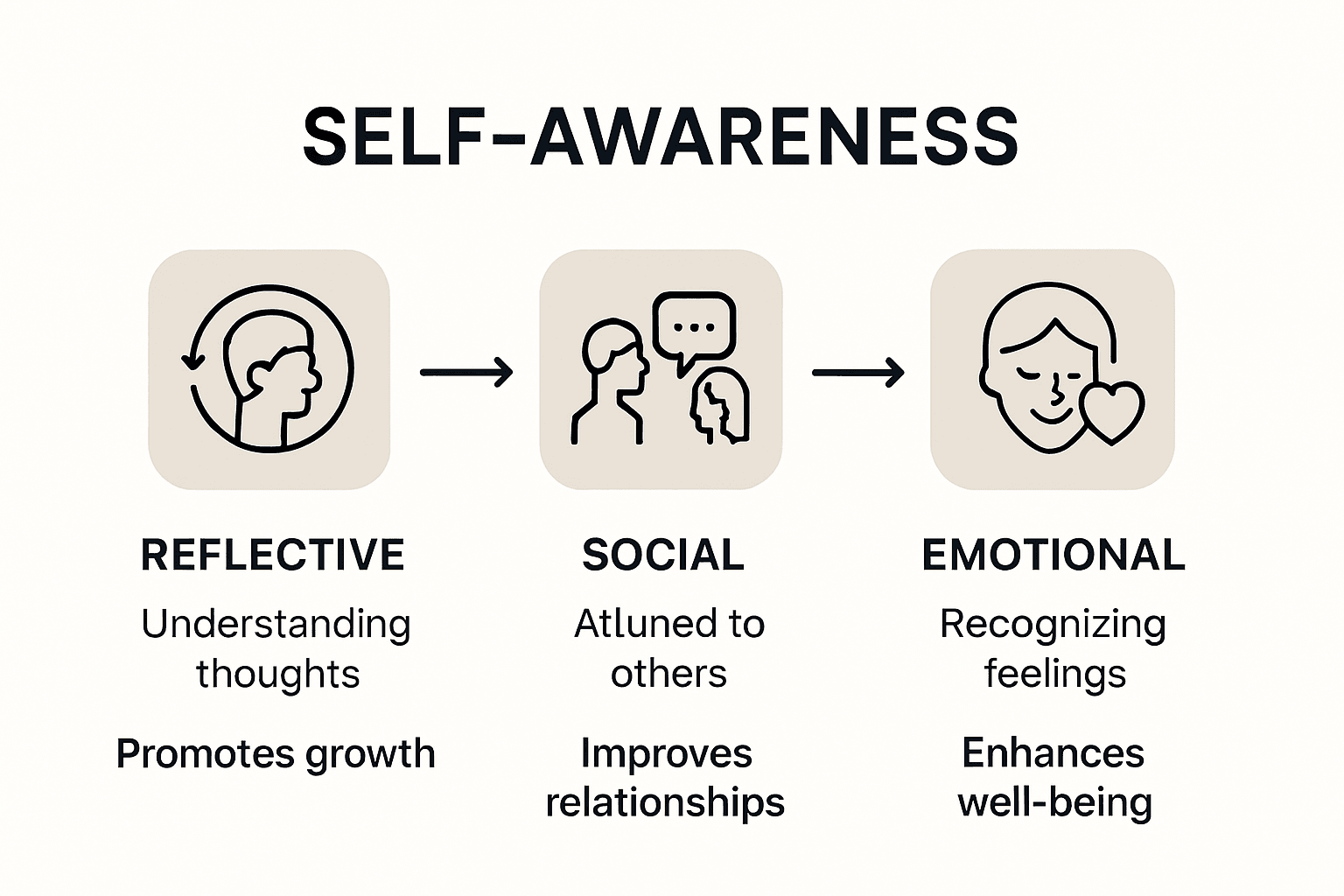
Each type of self-awareness offers unique insights and opportunities for personal growth. By developing a multifaceted approach to understanding yourself, you create a powerful toolkit for navigating complex personal and professional interactions. This holistic perspective enables more authentic connections, improved decision making, and a deeper sense of personal empowerment.
Here’s a comparison of the primary types of self-awareness and their distinct contributions:
| Type of Self-Awareness | Main Focus | Key Benefit |
|---|---|---|
| Reflective | Internal thoughts and patterns | Enables personal insight and growth |
| Social | Others’ perceptions of self | Enhances communication and relationships |
| Emotional | Recognition of emotional states | Improves emotional regulation and resilience |
Pro Tip: Self-Awareness Mapping: Create a personal journal with three columns representing reflective, social, and emotional self-awareness. Regularly document observations in each category to track your personal growth journey.
How Self-Awareness Drives Effective Change
Self-awareness acts as a powerful catalyst for personal transformation, serving as the foundational engine of meaningful change. Developing self-awareness enables individuals to comprehend their thoughts, emotions, and actions, leading to the identification of strengths and weaknesses and fostering personal development.

The mechanism of change through self-awareness operates on multiple levels. When we become consciously attuned to our internal patterns, we create a critical space between stimulus and response. This pause allows us to interrupt automatic behavioral cycles and make deliberate, thoughtful choices. Instead of reacting impulsively, we can strategically evaluate our options, aligning our actions with our deeper values and long-term goals.
Self-awareness transforms personal challenges into opportunities for growth by providing unprecedented insights into our psychological landscape. By understanding our emotional triggers, unconscious biases, and habitual thought patterns, we can systematically deconstruct limiting beliefs and replace them with more empowering perspectives. This process isn’t about perfection but about progressive, intentional personal evolution.
The true power of self-awareness lies in its ability to bridge the gap between understanding and action. Recognizing a pattern is only the first step; the real transformation happens when we courageously implement changes, consistently practice new behaviors, and hold ourselves accountable. This ongoing process of self-reflection, insight, and intentional action creates a dynamic framework for continuous personal development.
Pro Tip: Change Tracking Method: Create a weekly reflection journal documenting one observed pattern, its potential impact, and a specific actionable step to address or modify that pattern.
Real-World Benefits for Work and Wellbeing
Self-awareness transcends personal development, offering tangible benefits across professional and personal domains. Self-awareness contributes to creating new value, reconciling tensions, and taking responsibility, which are essential for confident and reflective lifelong learners in a rapidly changing world.
In the professional landscape, self-aware individuals demonstrate remarkable adaptability and emotional intelligence. They navigate workplace challenges with greater resilience, communicate more effectively, and build stronger interpersonal relationships. By understanding their personal triggers, communication styles, and emotional responses, professionals can manage conflicts more constructively, collaborate more seamlessly, and position themselves as thoughtful, strategic team members.
Self-acceptance, a critical component of self-awareness, involves recognizing one’s strengths and weaknesses, leading to greater personal satisfaction and improved mental health. This holistic understanding enables individuals to leverage their unique capabilities while developing strategies to address potential limitations. In the workplace, this translates to more authentic leadership, more genuine professional interactions, and a more balanced approach to career development and personal growth.
Beyond professional contexts, self-awareness profoundly impacts overall wellbeing. It allows individuals to cultivate more meaningful relationships, make more aligned life choices, and develop a deeper sense of personal agency. By consistently practicing self-reflection, people can break free from unconscious patterns, reduce stress, and create more intentional, fulfilling life experiences.
Pro Tip: Professional Insight Mapping: Spend 15 minutes weekly documenting your workplace interactions, emotional responses, and personal reactions to identify patterns and potential areas for personal and professional growth.
Common Barriers and How to Overcome Them
Self-awareness is a powerful journey, but it’s not without its challenges. Excessive self-consciousness can lead to heightened self-awareness that impairs performance and is associated with shyness or low self-esteem. Understanding these barriers is the first critical step in developing a more authentic and empowered approach to personal growth.
One of the most significant obstacles to self-awareness is our natural tendency towards self-protection. Fear of vulnerability often prevents individuals from conducting honest self-examination. We construct psychological defense mechanisms that shield us from uncomfortable truths, creating blind spots in our understanding of ourselves. These defense mechanisms manifest as rationalizations, blame-shifting, and unconscious avoidance of challenging emotional territories.
Limitations in self-knowledge arise from the complexity of introspection and the potential for flawed self-concepts. Cognitive biases play a significant role in distorting our perception, making it challenging to view ourselves objectively. Confirmation bias leads us to seek information that supports our existing beliefs, while the Dunning-Kruger effect can inflate our perception of personal competence. Overcoming these barriers requires a commitment to intellectual humility and a willingness to challenge our own assumptions.
Successful self-awareness demands a delicate balance between compassionate self-reflection and critical analysis. It’s about creating a safe internal environment where you can explore your thoughts, emotions, and behaviors without harsh judgment. This approach transforms self-examination from a potentially painful process into an opportunity for growth, understanding, and personal transformation.
Below is a summary of common barriers to self-awareness and suggested methods to overcome them:
| Barrier | How It Manifests | Overcoming Strategy |
|---|---|---|
| Fear of vulnerability | Avoiding honest self-reflection | Practice nonjudgmental self-exploration |
| Psychological blind spots | Rationalizing or blame-shifting | Seek feedback and embrace discomfort |
| Cognitive biases | Distorted self-perception | Challenge assumptions and seek objectivity |
Pro Tip: Barrier Breaking Practice: Dedicate 10 minutes daily to journaling, focusing specifically on challenging your own assumptions and exploring perspectives that feel uncomfortable or contrary to your current beliefs.
Unlock Your Potential with Guided Self-Awareness Practice
The article highlights the challenges many face when striving to develop true self-awareness, such as overcoming cognitive biases and fear of vulnerability. If you find yourself wanting to deepen your emotional self-awareness, master reflective insight, or improve social understanding to enhance both personal growth and professional wellbeing, you are not alone. These are crucial steps to transform automatic reactions into conscious, empowered choices.
Boldly embrace this journey with expert guidance. At Monikavarela.com, psychologist and mindfulness coach Monika Varela offers tailored psychotherapy, mindfulness workshops, and communication coaching designed to help you identify and overcome the barriers to self-awareness described in the article. Her inclusive approach ensures a safe space for you to explore your inner experiences, challenge limiting beliefs, and cultivate emotional resilience.
Discover how to make self-awareness a practical, life-enhancing skill rather than an abstract ideal.
Ready to transform your personal and professional life through mindful self-awareness? Visit Monikavarela.com today to explore personalized programs that support your growth. Take your first step toward lasting change and well-being by securing your online session or inquiry now.
Frequently Asked Questions
Why is self-awareness important for personal growth?
Self-awareness is crucial for personal growth as it allows individuals to understand their emotions, thoughts, and behaviors, which leads to better decision-making and alignment with core values.
What are the different types of self-awareness?
The three primary types of self-awareness are reflective self-awareness, which focuses on internal thoughts; social self-awareness, which pertains to how others perceive you; and emotional self-awareness, which involves recognizing and managing emotional responses.
How can I practice self-awareness effectively?
Effective practice of self-awareness can be done through daily journaling about your emotions and reactions, engaging in honest self-reflection, and seeking feedback from others to gain new perspectives on your behaviors.
What barriers might hinder my self-awareness and how can I overcome them?
Common barriers include fear of vulnerability, psychological blind spots, and cognitive biases. Overcoming these requires creating a safe space for self-examination, embracing discomfort, and being open to challenge your own assumptions.
Recommended
- Mindful Self-Awareness: Complete Guide for Professionals – Mónika Varela
- Best 7 Mindfulness Tools for Professionals – Expert Comparison 2025 – Mónika Varela
- Mindfulness Builds Confidence: Quiet Inner Critic & Boost Self‑Esteem – Mónika Varela
- What Are Mindfulness Workshops? Complete Guide 2024 – Mónika Varela





Aún no hay comentarios, ¡añada su voz abajo!