


Most American and Spanish managers underestimate how much self-awareness drives team performance. Studies reveal that leaders with high emotional intelligence are up to 31 percent more effective at managing workplace relationships. In multinational corporations, understanding your strengths, emotional triggers, and communication style is more than a personal skill—it shapes team dynamics and organizational outcomes. This guide shows how practical self-awareness strategies transform leadership, boost collaboration, and remove barriers to growth for busy mid-level managers.
Table of Contents
- Defining Self-Awareness In The Workplace
- Types And Dimensions Of Self-Awareness
- Essential Self-Awareness Skills For Managers
- Daily Applications To Leadership And Teamwork
- Common Barriers And How To Overcome Them
Key Takeaways
| Point | Details |
|---|---|
| Importance of Self-Awareness | Self-awareness enhances emotional intelligence, communication, and team dynamics for managers in multinational settings. |
| Types of Self-Awareness | Internal, external, and contextual self-awareness are crucial for comprehensive leadership and interpersonal skills. |
| Essential Skills for Managers | Key skills include emotional intelligence, reflective practice, and psychological agility, all vital for effective leadership. |
| Overcoming Barriers | Managers should create psychological safety and invite feedback to combat psychological and organizational barriers to self-awareness. |
Defining Self-Awareness in the Workplace
Self-awareness represents the foundational psychological skill where professionals understand their emotions, behaviors, strengths, and limitations within workplace environments. For mid-level managers in multinational corporations, this capacity goes beyond simple introspection and transforms into a strategic competency that directly influences team dynamics, communication effectiveness, and overall organizational performance.
At its core, workplace self-awareness involves three critical dimensions: emotional intelligence, behavioral recognition, and professional adaptability. Emotional intelligence allows managers to recognize their internal emotional states and understand how these feelings impact team interactions. Behavioral recognition enables professionals to objectively assess their communication patterns, leadership approaches, and potential blind spots. Professional adaptability emerges when individuals can modify their behaviors based on self-reflective insights, creating more responsive and empathetic work environments.
The practical manifestation of self-awareness appears through multiple observable behaviors. Managers demonstrate this skill by actively seeking feedback, reflecting on performance reviews, acknowledging personal limitations, and maintaining transparent communication about their developmental areas. These actions create psychological safety within teams, encouraging open dialogue and mutual understanding. By modeling vulnerability and continuous learning, self-aware leaders signal that professional growth is a collective, iterative process rather than a rigid, judgmental evaluation.
Pro tip: Schedule a monthly 30-minute personal reflection session where you document your professional interactions, emotional responses, and potential areas of improvement, treating self-awareness as an ongoing strategic skill development process.
Types and Dimensions of Self-Awareness
Self-awareness is not a monolithic concept but a multifaceted psychological framework with distinct types and nuanced dimensions that significantly impact professional performance. For mid-level managers navigating complex multinational environments, understanding these variations becomes crucial for developing comprehensive interpersonal and leadership skills.
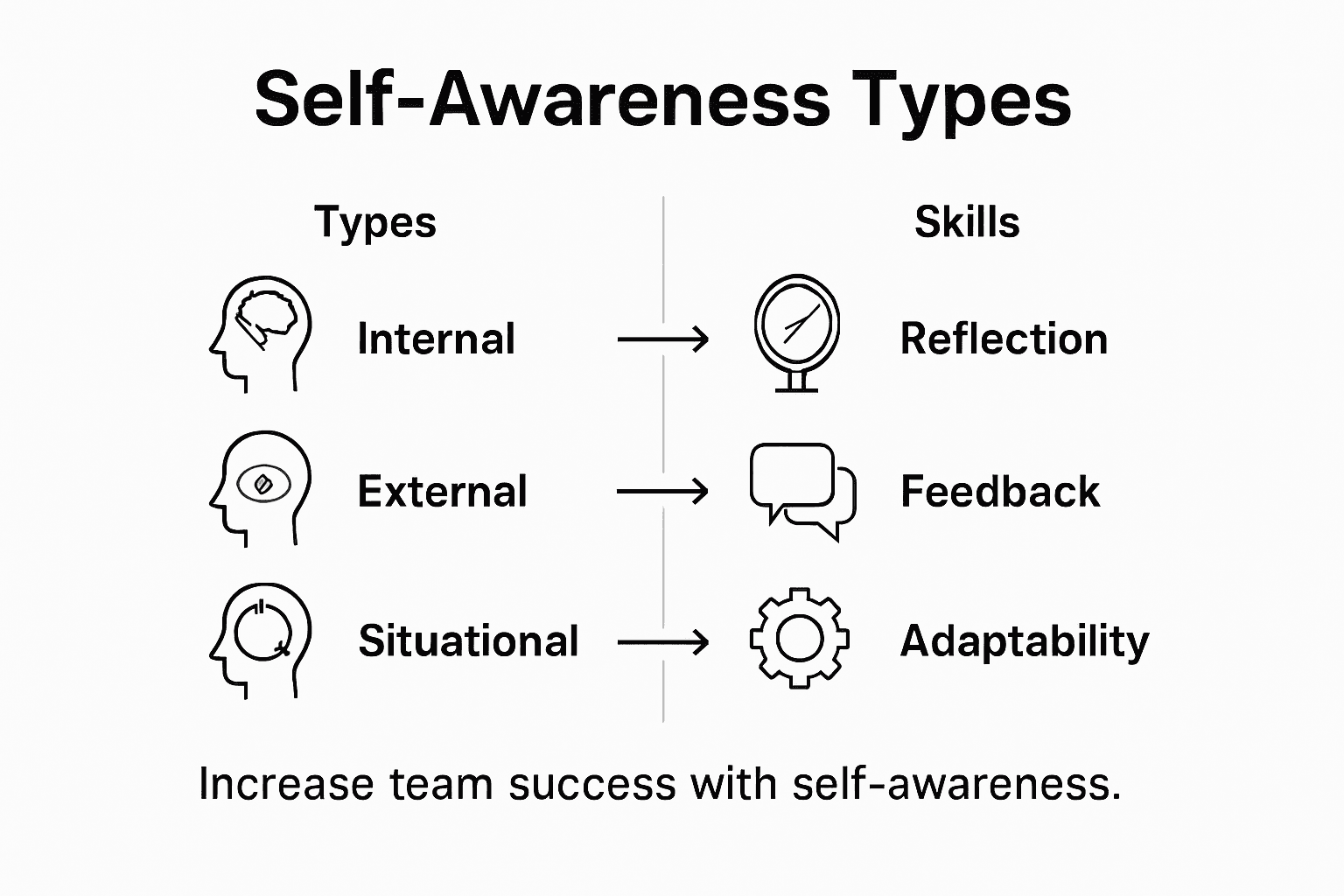
The primary types of self-awareness can be categorized into three fundamental dimensions: internal self-awareness, external self-awareness, and contextual self-awareness. Internal self-awareness involves recognizing personal emotions, motivations, strengths, and limitations. External self-awareness focuses on understanding how others perceive one’s behaviors, communication patterns, and professional persona. Contextual self-awareness represents the ability to adapt one’s understanding and behaviors across different organizational and cultural environments.
Each dimension of self-awareness operates through specific cognitive and emotional mechanisms. Internal self-awareness emerges through introspective practices like journaling, meditation, and structured reflection. External self-awareness develops through active feedback solicitation, empathetic listening, and interpersonal dialogue. Contextual self-awareness requires continuous learning, cultural intelligence, and the capacity to navigate diverse professional landscapes with flexibility and emotional agility.
To better understand the main types of self-awareness and how they operate, see the summary below:
| Type of Self-Awareness | Key Focus | How It’s Developed |
|---|---|---|
| Internal | Personal emotions, strengths | Reflection, journaling, meditation |
| External | Others’ perceptions of you | Feedback, active listening |
| Contextual | Adapting to different environments | Cultural learning, flexibility |
Pro tip: Create a quarterly 360-degree feedback matrix where you gather perspectives from peers, supervisors, and direct reports to systematically map your professional self-perception against external perceptions.
Essential Self-Awareness Skills for Managers
Effective managers must cultivate a robust set of self-awareness skills that go beyond traditional leadership competencies. Current leadership development research emphasizes that self-leadership and mindfulness training are critical for enhancing emotional regulation, stress resilience, and interpersonal relationship capabilities in complex organizational environments.
Key self-awareness skills for managers can be categorized into five essential domains: emotional intelligence, reflective practice, feedback receptivity, adaptive communication, and psychological agility. Emotional intelligence involves recognizing and managing personal emotional states while understanding their impact on team dynamics. Reflective practice requires systematic self-examination of leadership approaches, decision-making patterns, and personal biases. Feedback receptivity demands creating psychological safety where constructive criticism is welcomed and integrated into professional development.
Adaptive communication and psychological agility represent advanced self-awareness competencies where managers can dynamically adjust their communication style, leadership approach, and interpersonal strategies based on contextual understanding. Fundamental leadership research highlights that these skills enable managers to build trust, resolve conflicts effectively, and maintain empathy across diverse workplace environments. The ability to recognize personal limitations while continuously learning becomes a strategic advantage in multinational corporate settings.
Here’s how core self-awareness skills translate to leadership advantages:
| Self-Awareness Skill | Leadership Benefit | Team Impact |
|---|---|---|
| Emotional Intelligence | Improved emotional regulation | Increased trust |
| Feedback Receptivity | Better growth mindset | Openness to change |
| Adaptive Communication | More effective messaging | Reduced misunderstandings |
| Reflective Practice | Higher decision quality | Stronger team cohesion |
| Psychological Agility | Faster response to challenges | Greater team resilience |
Pro tip: Develop a personal leadership journal where you document weekly leadership interactions, emotional triggers, communication effectiveness, and personal growth insights to systematically enhance your self-awareness skills.
Daily Applications to Leadership and Teamwork
Self-awareness transforms from an abstract concept to a practical leadership tool when integrated into daily workplace interactions. Emotionally intelligent leaders apply self-awareness strategies that directly influence team dynamics, communication effectiveness, and organizational performance through consistent, intentional practices.
Practical daily applications of self-awareness in leadership encompass multiple strategic approaches. Communication becomes more nuanced as managers learn to pause and reflect before responding, actively listening to understand rather than merely waiting to speak. Conflict resolution improves when leaders recognize their emotional triggers and can manage personal reactions objectively. Team meetings transform from routine gatherings into opportunities for mutual understanding, where emotional intelligence guides collaborative problem-solving and creates psychological safety.
Leadership research consistently demonstrates that self-aware managers excel in creating adaptive work environments. This involves regularly checking personal biases, soliciting honest feedback, and demonstrating vulnerability by acknowledging personal limitations. The most effective leaders view self-awareness as a continuous learning process, using daily interactions as opportunities to understand themselves and their team members more deeply. By modeling transparent communication, emotional regulation, and genuine curiosity about team dynamics, managers can systematically build trust and enhance collective performance.

Pro tip: Implement a daily 10-minute reflection practice where you journal about your leadership interactions, emotional responses, and potential areas of personal and team improvement.
Common Barriers and How to Overcome Them
Self-awareness development encounters numerous psychological and organizational obstacles that can significantly impede personal and professional growth. Managers frequently face complex internal and external challenges that create resistance to genuine self-reflection and emotional intelligence development.
The primary barriers to self-awareness can be categorized into four critical domains: psychological defense mechanisms, organizational culture limitations, cognitive biases, and emotional blindspots. Psychological defense mechanisms like rationalization and projection prevent individuals from acknowledging uncomfortable truths about their behaviors and leadership styles. Organizational cultures that prioritize performance metrics over personal development can discourage vulnerability and genuine self-examination. Cognitive biases such as confirmation bias and the Dunning-Kruger effect create significant distortions in self-perception, making objective self-assessment extremely challenging.
Overcoming these barriers requires a multifaceted, intentional approach. Managers must cultivate psychological safety within themselves and their teams, creating environments where honest feedback is welcomed and personal growth is celebrated. This involves developing active listening skills, practicing radical candor, and creating structured reflection processes that systematically challenge existing mental models. Techniques like external coaching, peer feedback mechanisms, and regular self-assessment workshops can help break down defensive psychological barriers and promote more authentic leadership approaches.
Pro tip: Establish a quarterly personal development audit where you invite trusted colleagues to provide anonymous, comprehensive feedback about your leadership blind spots and potential areas of improvement.
Elevate Your Leadership Through Deeper Self-Awareness
Unlock the power of self-awareness to transform team success and personal growth. This article highlights key challenges managers face, such as recognizing emotional triggers, overcoming blind spots, and adapting communication styles for diverse teams. Developing skills like emotional intelligence and feedback receptivity is essential for creating trust and resilience in multinational workplaces. If you want to move beyond theory and actively apply self-awareness techniques in your leadership style, hands-on guidance and mindful strategies are crucial.
Take the next step toward becoming the self-aware leader your team needs. Explore expert coaching, mindfulness workshops, and personalized psychotherapy at Monikavarela.com. Learn how to integrate reflective practice and emotional regulation into your daily routine through services designed to enhance communication skills and mental wellness. Don’t wait to build the emotional agility that drives lasting team engagement and professional success. Visit Monika Varela’s professional site today to start your journey and book a session tailored to your unique leadership challenges.
Frequently Asked Questions
What is self-awareness in the workplace?
Self-awareness in the workplace is the ability of professionals to understand their emotions, behaviors, strengths, and limitations, which significantly impacts communication, team dynamics, and overall performance.
How does self-awareness influence team success?
Self-awareness fosters better communication, enhances emotional intelligence, creates psychological safety, and encourages open dialogue, all of which contribute to increased team cohesion and success.
What are some practical ways to develop self-awareness as a manager?
Managers can develop self-awareness by engaging in reflective practices like journaling, seeking feedback from peers, participating in training programs focused on emotional intelligence, and regularly assessing their leadership styles.
What common barriers hinder self-awareness at work?
Common barriers include psychological defense mechanisms, organizational culture limitations that prioritize metrics over personal growth, cognitive biases that distort self-perception, and emotional blind spots that prevent objective self-assessment.





Aún no hay comentarios, ¡añada su voz abajo!